The seven steps to getting your destination found (and booked) by AI.
08 October 2026
by Stefan Hawes, Chief AI Officer & Senior VP Marketing, Resonance

05 November 2026
by Stefan Hawes, Chief AI Officer, Resonance Consultancy
More and more trips now start with a question to an AI assistant. Where should we go for a long weekend? Which city should I move to? Where should we hold our next conference? IATA surveyed more than 10,000 air passengers in October, and 49% of them have already used AI to plan a trip.
That raises a question for every destination: when someone asks, does the AI name you?
To find out, we asked ChatGPT, Claude and Google AI Mode where to travel, live, do business and meet. We asked 30,020 times. Today we’re opening up the results as the Resonance AI Index, free for anyone who works on a place. I shared the first results at City Nation Place London this week, and here’s the full story, region by region.
You can look up your own destination for free in the Resonance AI Index.
We wrote 218 questions the way people actually type them. “Where should we hold a 3,000-person conference?” “Which city should I move to?” “Where should I start a tech company?” They cover four sectors: tourism, meetings, living and business. Some ask about the whole world. Others ask about one region: Europe, North America, Asia Pacific, Latin America, or the Middle East and Africa.
We asked from 10 home cities: Berlin, London, New York, Los Angeles, Tokyo, Sydney, São Paulo, Dubai, Johannesburg and Mumbai. And once more with no home city at all. We asked three of the most prominent AI assistants people use today: ChatGPT, Claude and Google AI Mode.
We ran seven waves between Sept. 18 and Oct 19. That’s 30,020 answers, and 2,444 different places named.
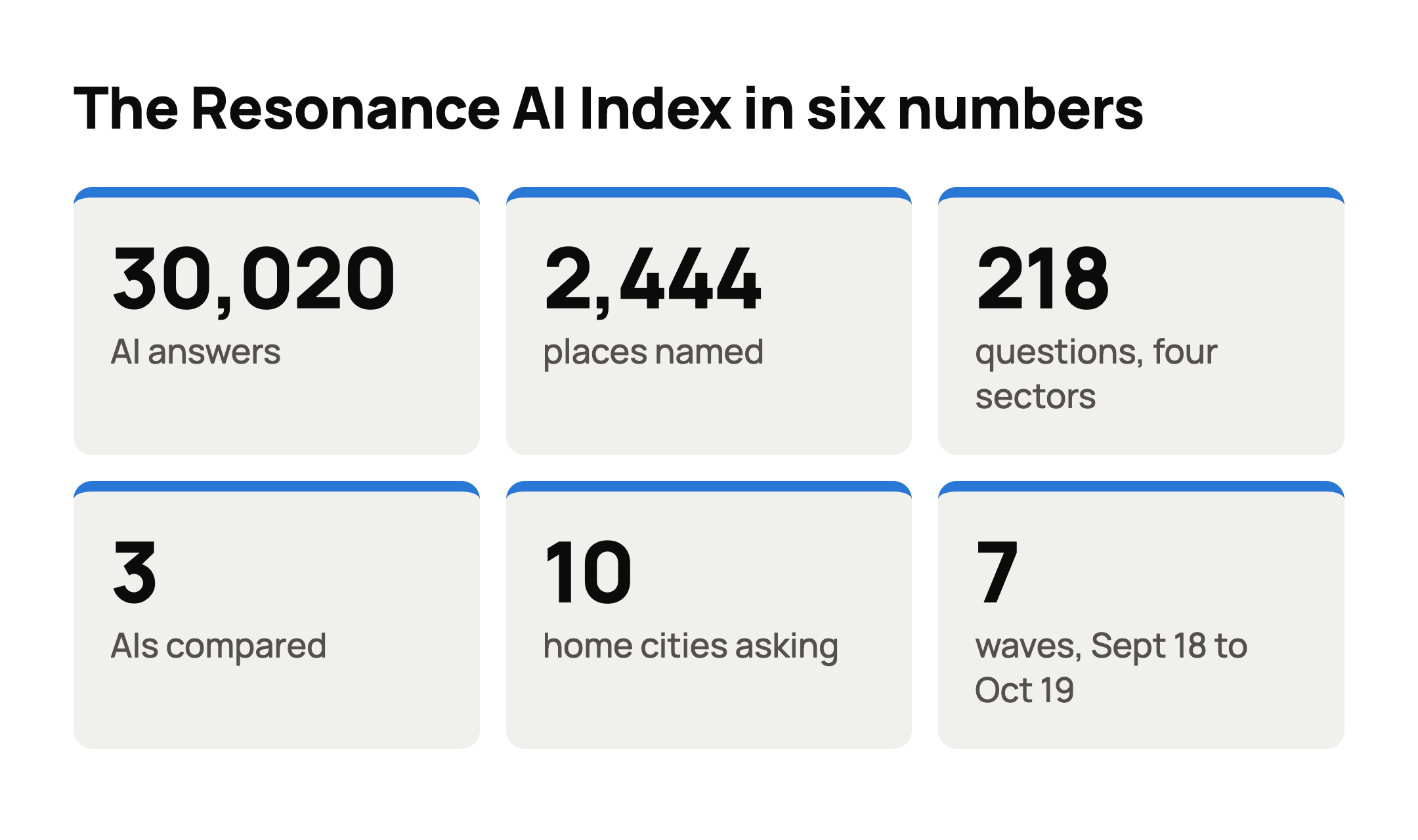
For every place, we track two numbers: how often the AIs name it at all, and how often they name it first, as their top pick.
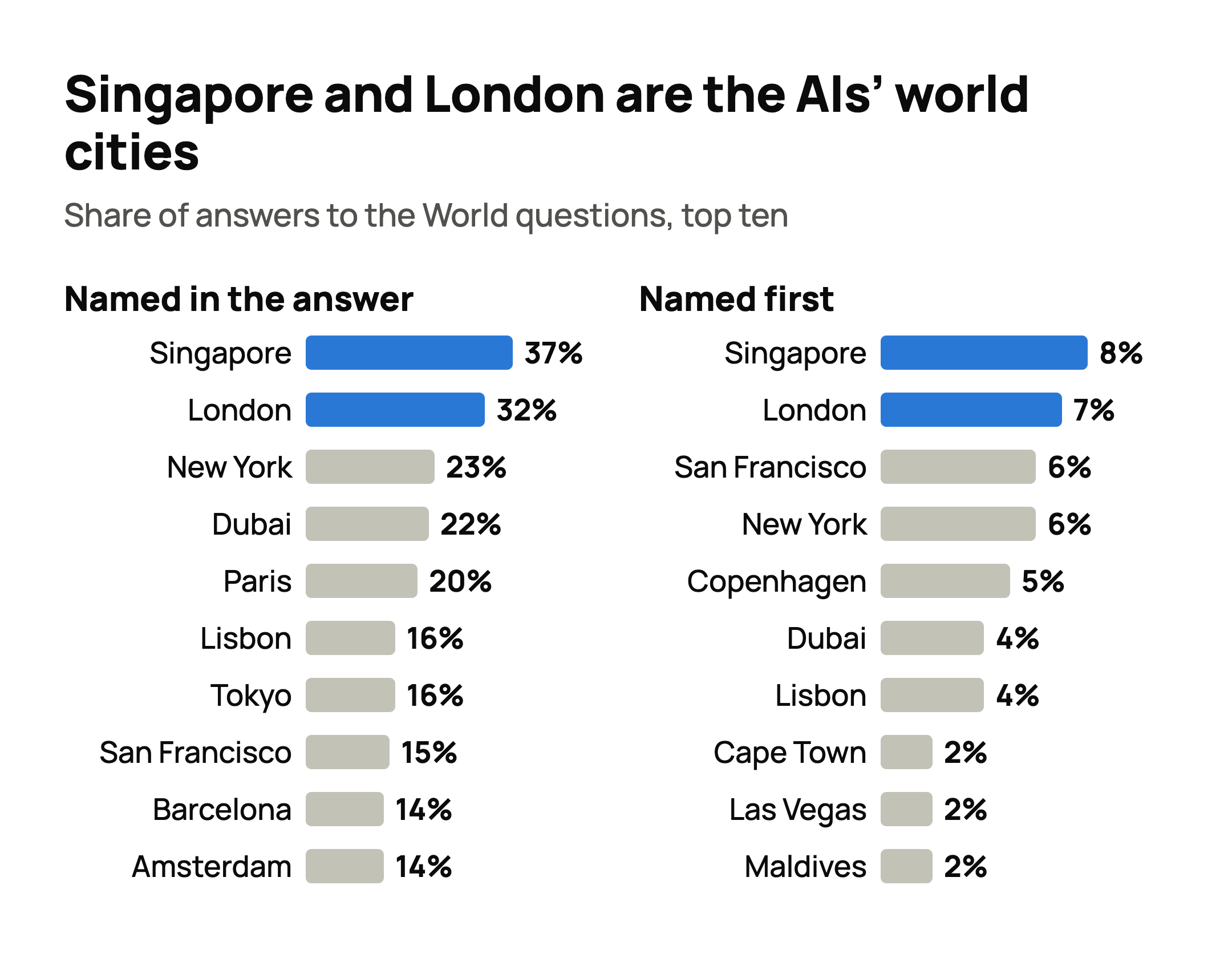
We learned early that when you ask the same AI the same question a week later, about half the places in the answer change. But across seven waves, the rankings barely moved. Week to week, the Europe and North America rankings correlate at 0.96 or higher. That’s why we measure over time, and why we trust the trend.
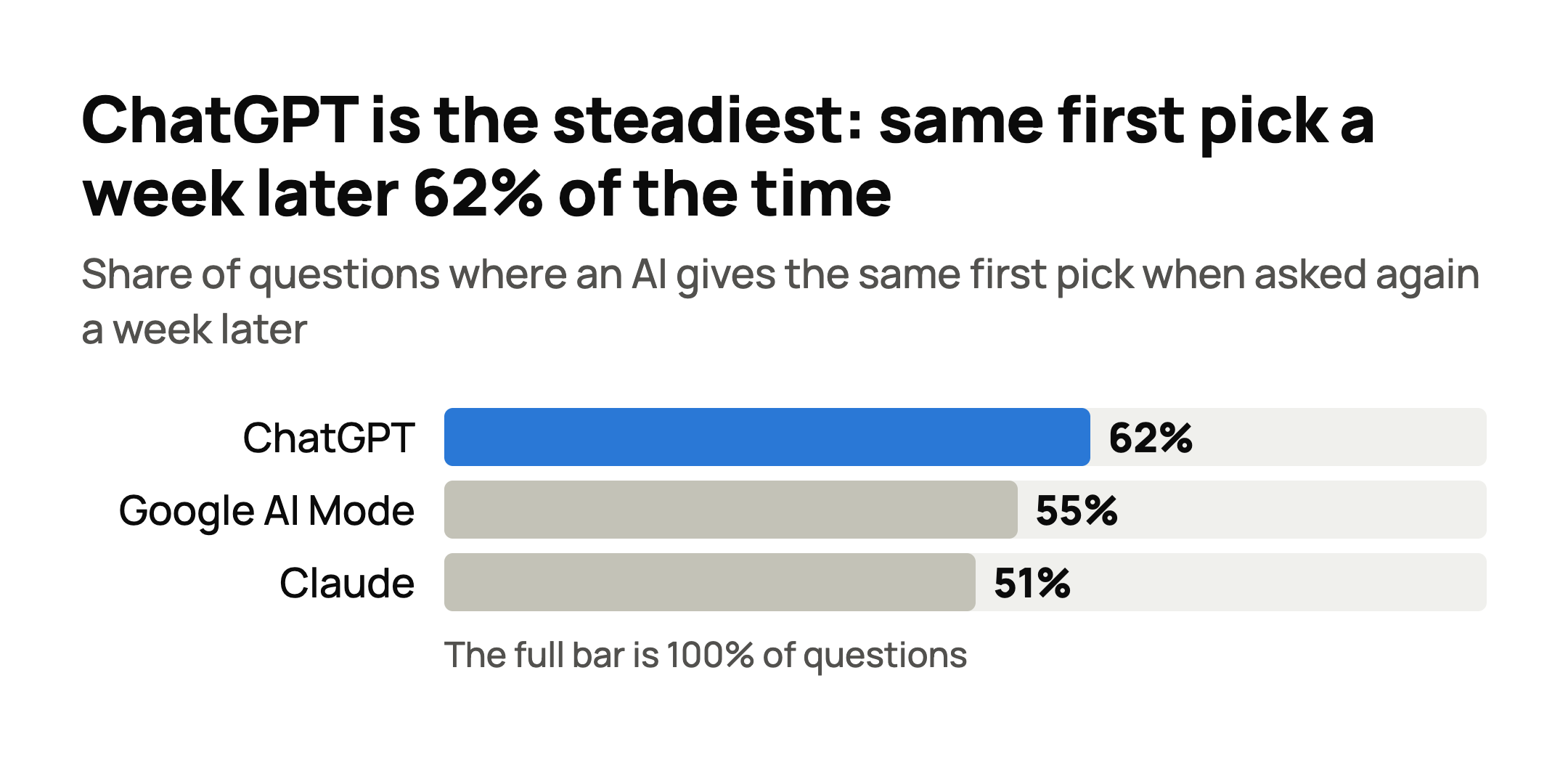
Worldwide, Singapore and London are the AIs’ world cities. Singapore is named in 37% of answers to our World questions, and London in 32%. New York, Dubai and Paris follow.
The first picks look different from the overall list. San Francisco is eighth for being named, but third for being named first. When people ask where to start a business or build an AI company, the AIs often put San Francisco at the top.(Could that be home town favouritism?) Copenhagen doesn’t make the top ten for being named at all, but it’s fifth for being named first. Ask which city has the best quality of life, and Copenhagen is often the first answer.
So when you look at your own numbers, understand which one you’re looking at, what it means and what drove your results.
Each region has its own board in the Index. A board uses only the questions about that region, so a city is measured against its neighbours. The number in each chart is the share of answers about that region that name the city.
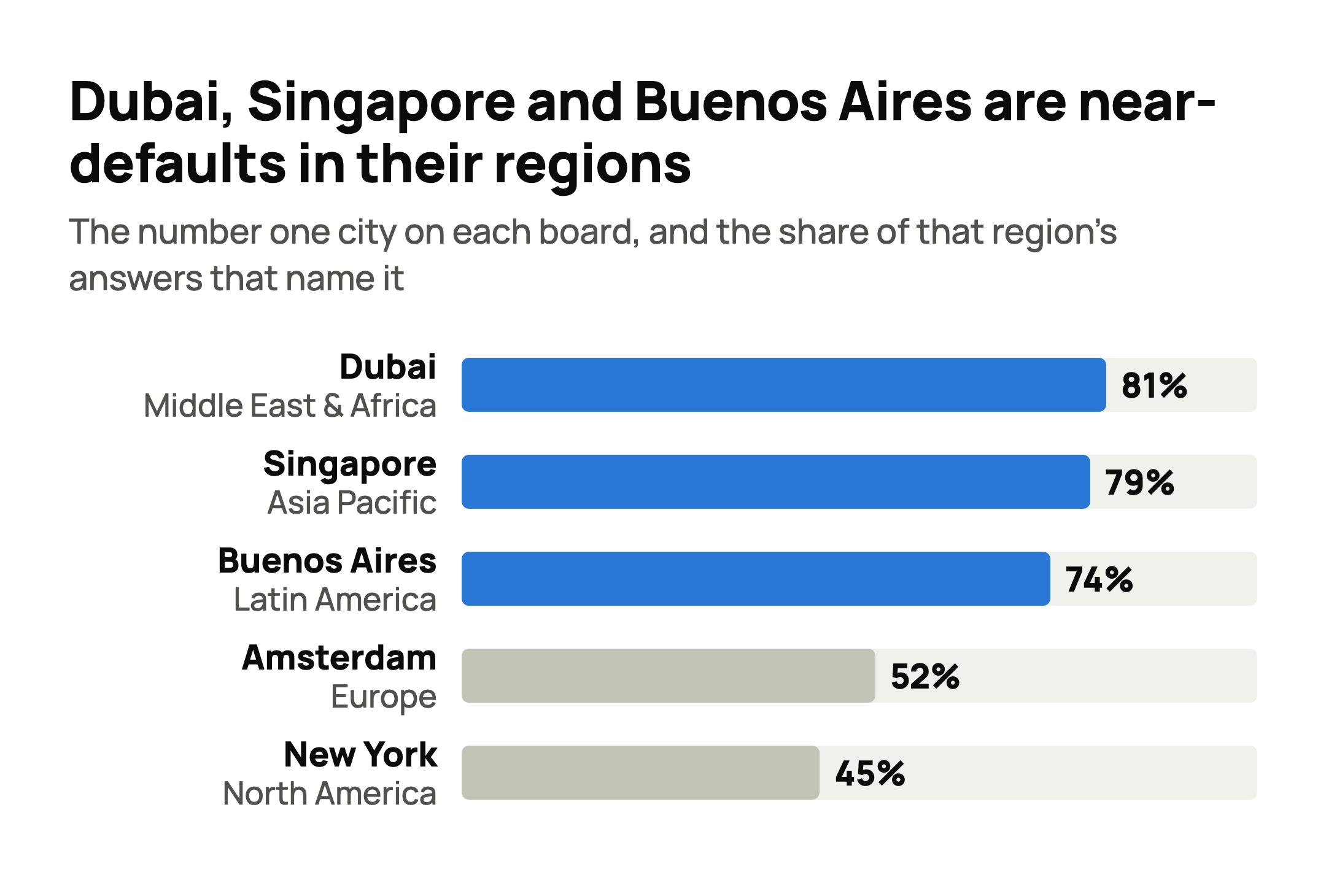
In three regions, one city is named in roughly three quarters of the answers or more. Europe and North America are the most open races.
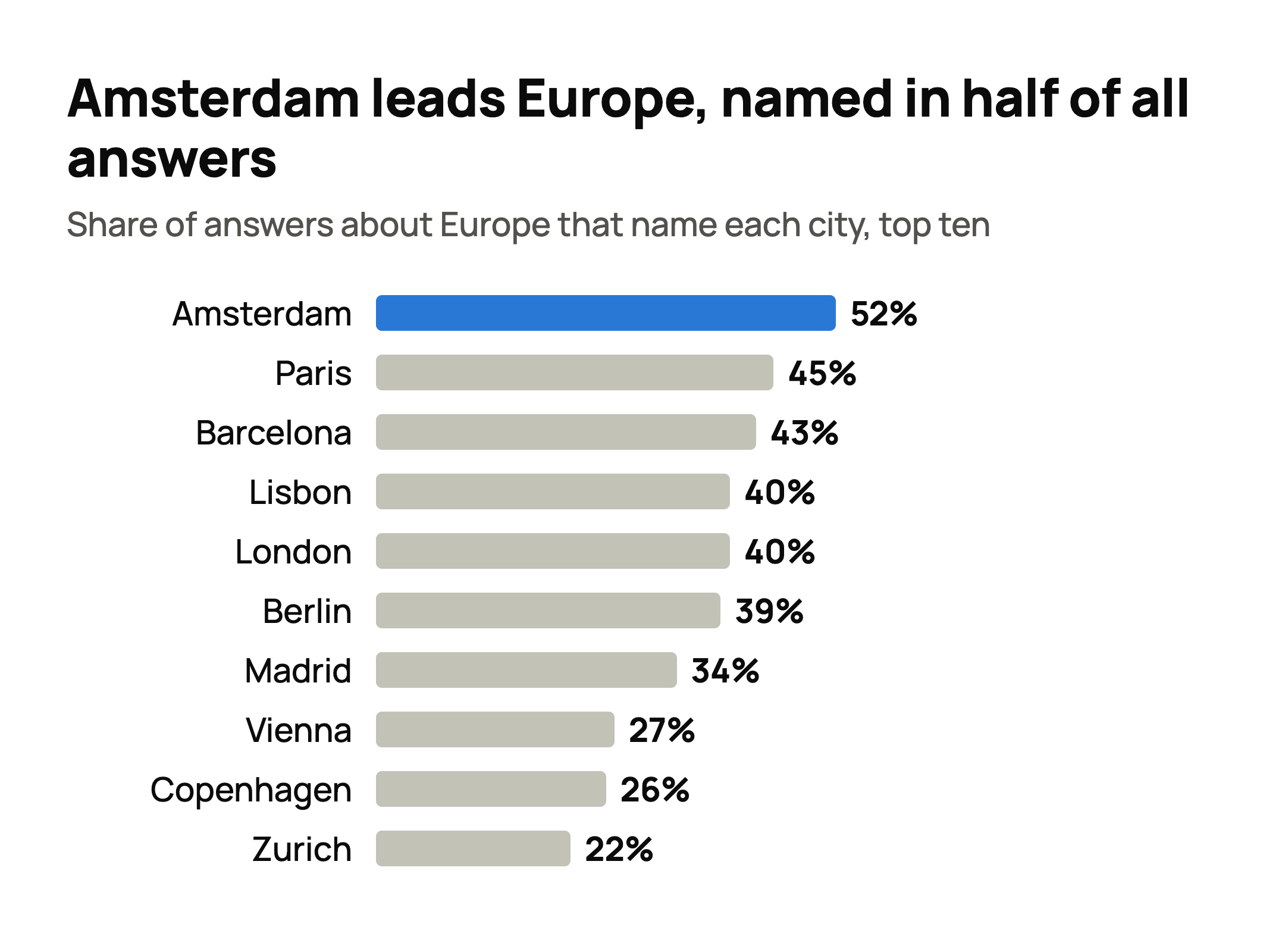
Amsterdam leads Europe, named in more than half of all answers about the continent. Paris, Barcelona, Lisbon and London follow, each at 40% or more. It’s the most crowded top five of any region: only 12 points separate first from fifth.
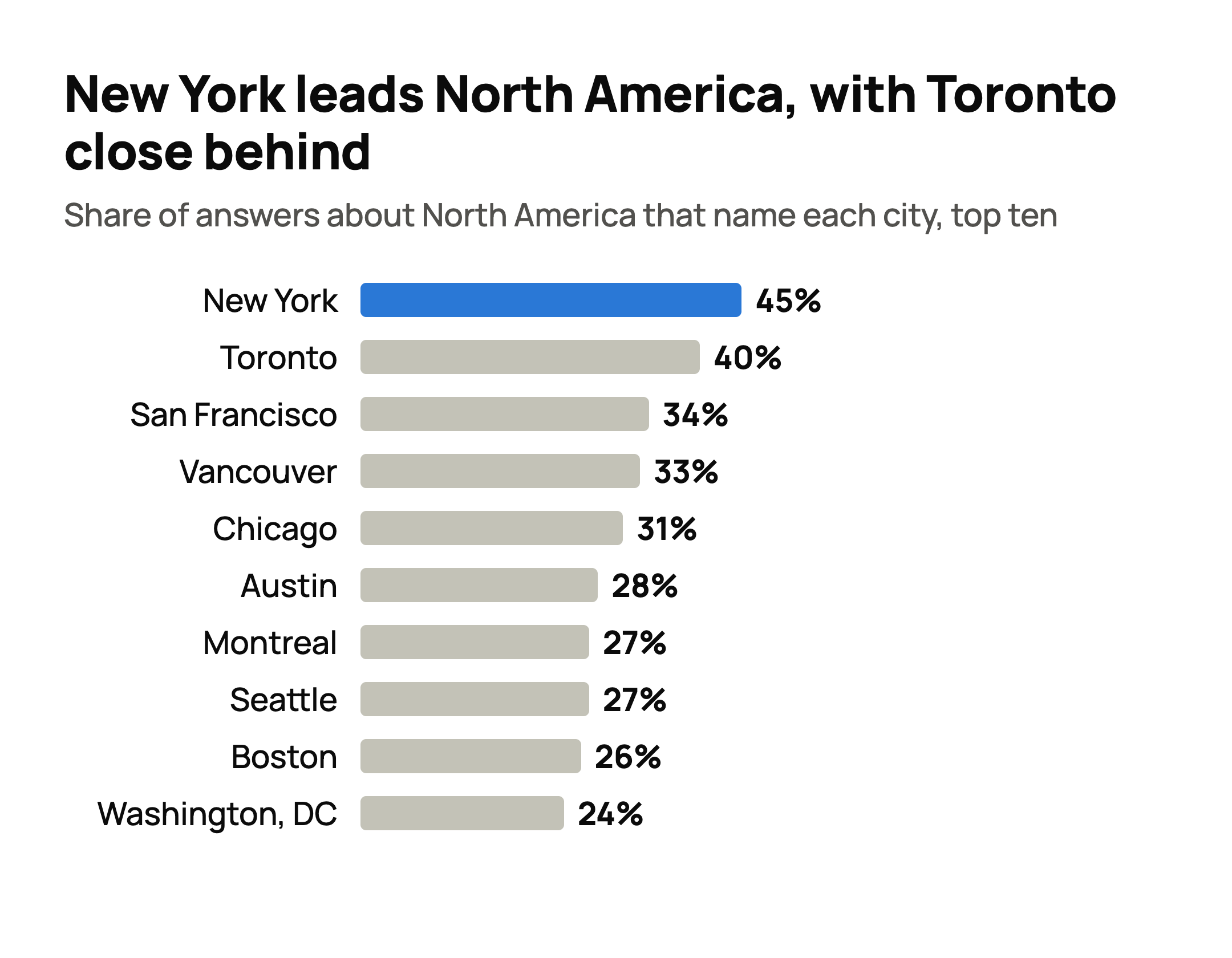
New York leads, then Toronto, San Francisco and Vancouver. Canada does well, with Toronto, Vancouver and Montreal all in the top seven.
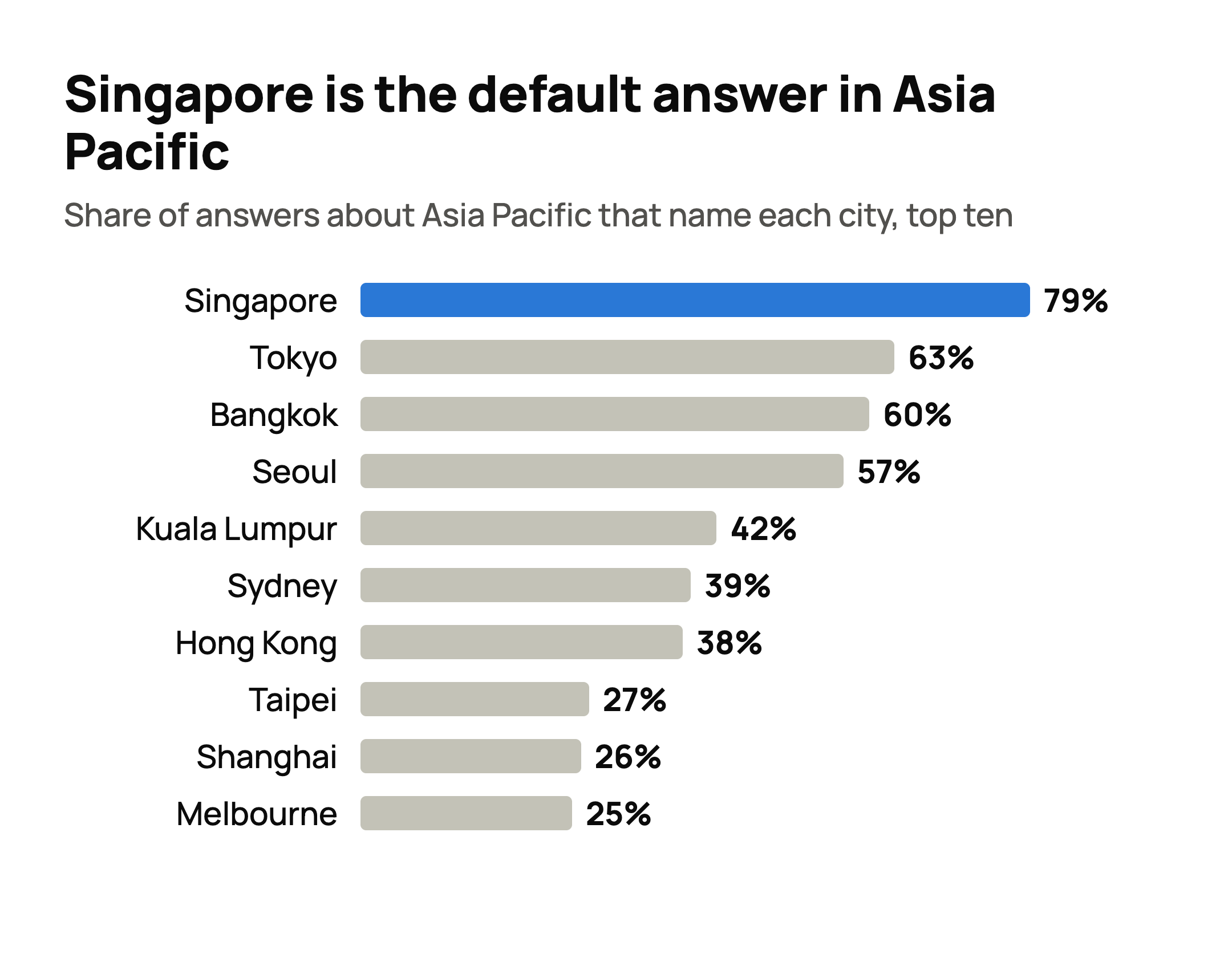
Singapore is named in 79% of answers about Asia Pacific. Tokyo, Bangkok and Seoul follow, each in more than half.
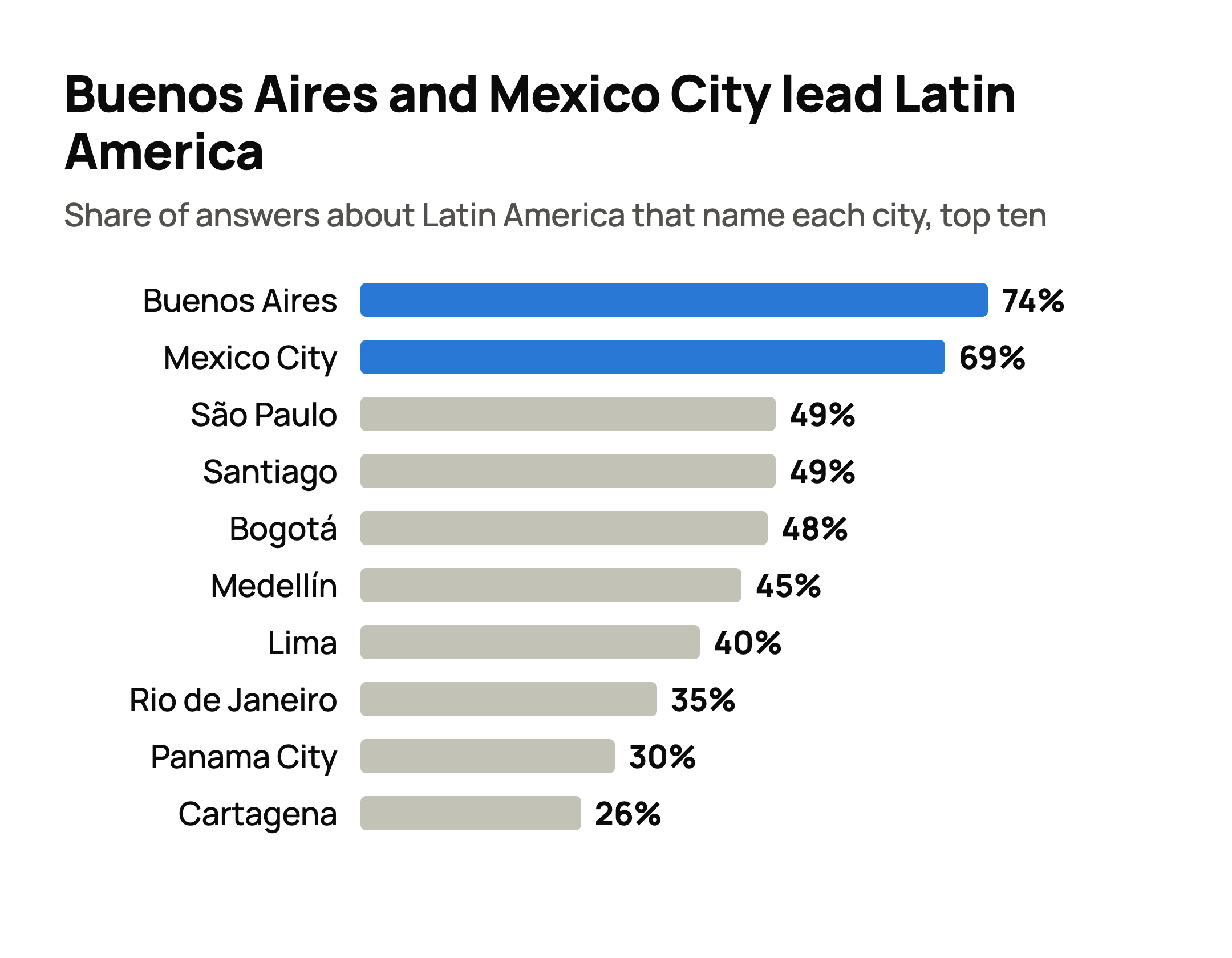
Latin America has two leaders. Buenos Aires is named in 74% of answers about the region, and Mexico City in 69%. Then there’s a step down to São Paulo, Santiago and Bogotá, each in just under half.
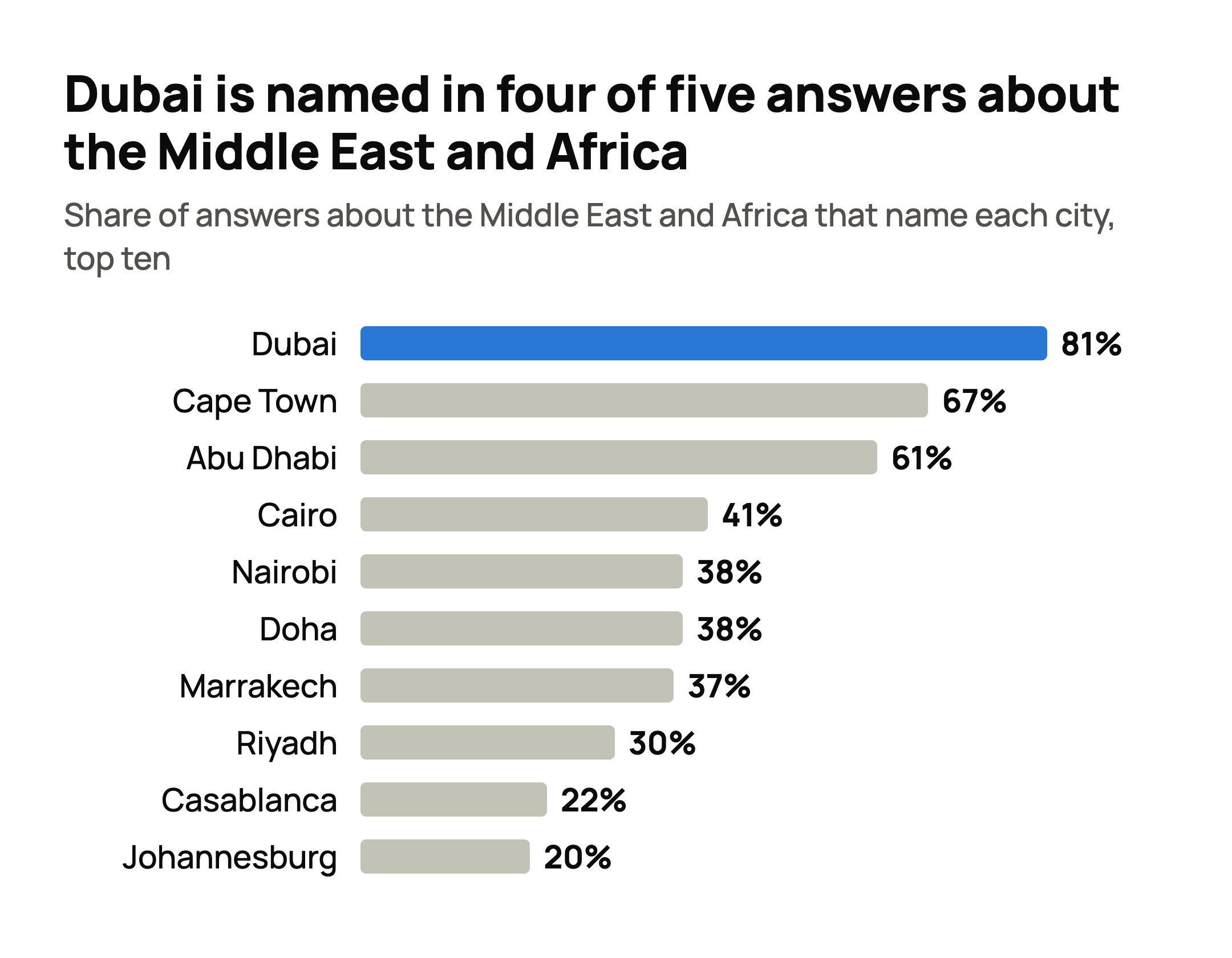
Dubai is the strongest default of any region, named in 81% of answers. Cape Town is second at 67%, then Abu Dhabi at 61%. After that the field opens up, with Cairo, Nairobi, Doha and Marrakech all close together.
Every board in the Index goes far beyond the top ten. Find your destination on its regional board.
Worldwide, the AIs answer holiday questions with countries and islands. Japan, Thailand, Bali and the Maldives lead tourism, and no ordinary city makes the top ten. The closest is Singapore, a city nation.
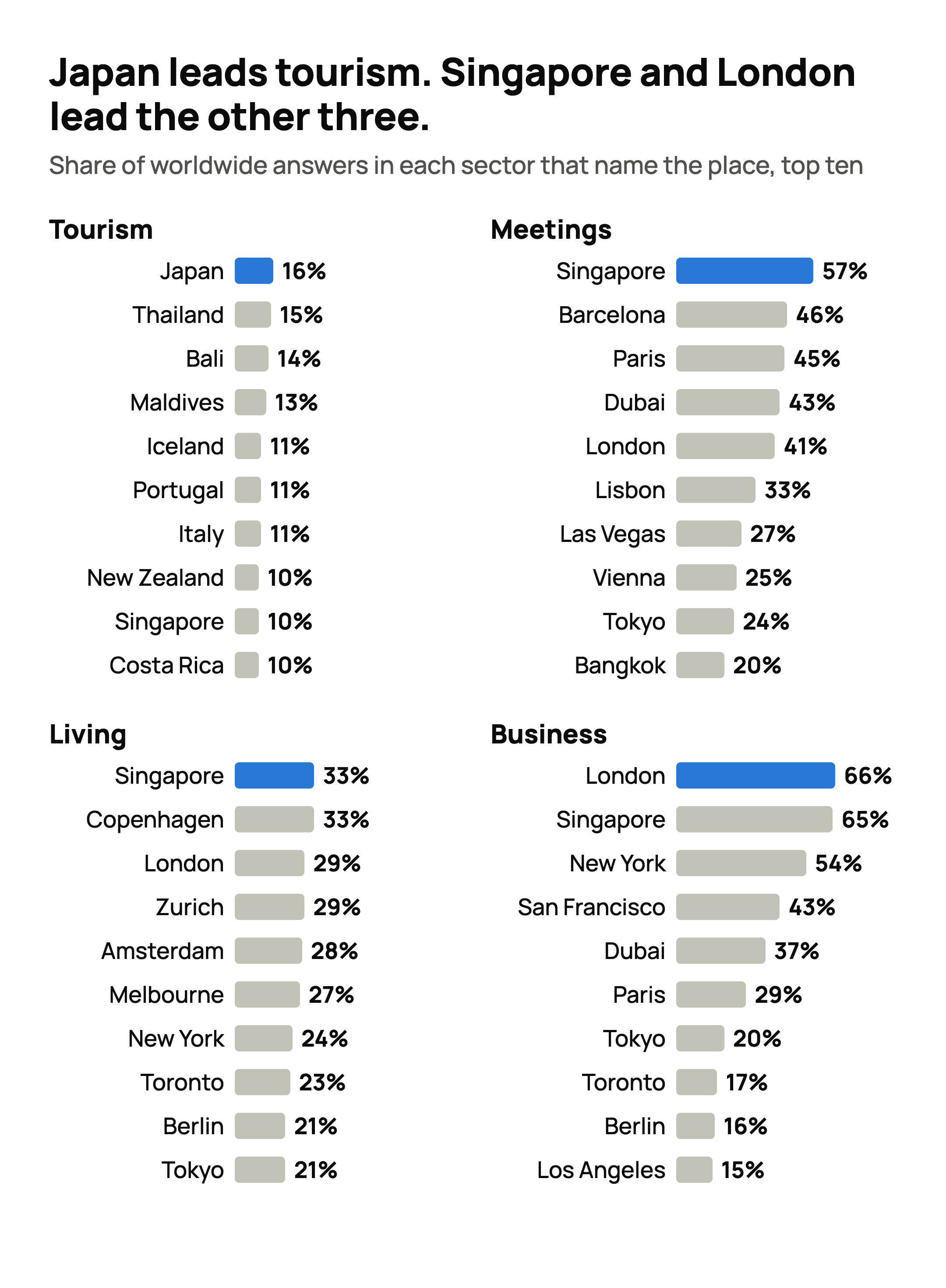
Meetings belong to Singapore, Barcelona, Paris, Dubai and London. For living, Copenhagen ties Singapore at the top. And business is London and Singapore, each named in about two thirds of answers.
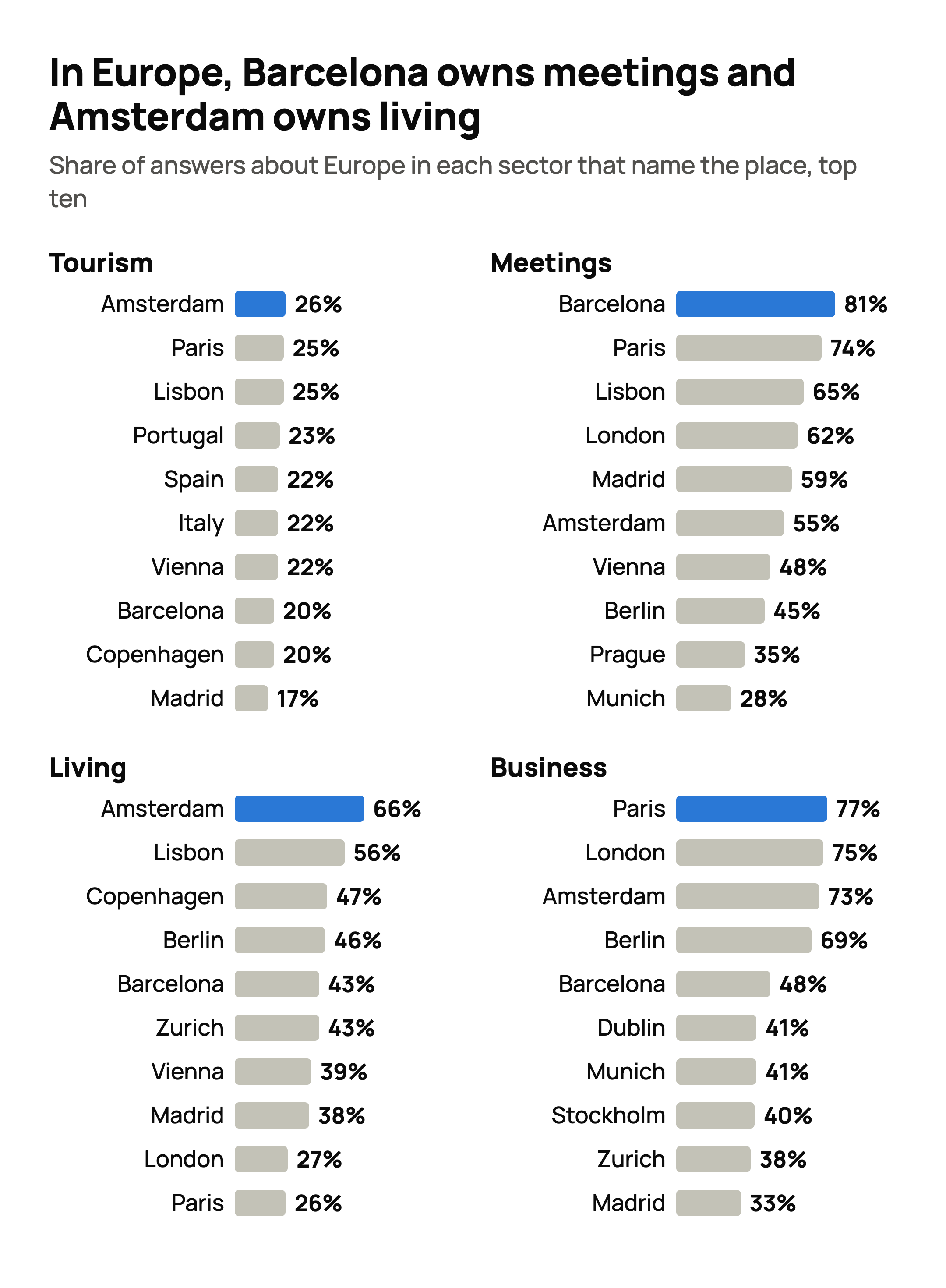
In Europe, meetings is Barcelona, named in 81% of answers, then Paris and Lisbon. Living is Amsterdam, in two thirds of answers, then Lisbon and Copenhagen. Business is a four-way race between Paris, London, Amsterdam and Berlin. Tourism is the most spread out, and the AIs often answer with a whole country, like Portugal, Spain or Italy.
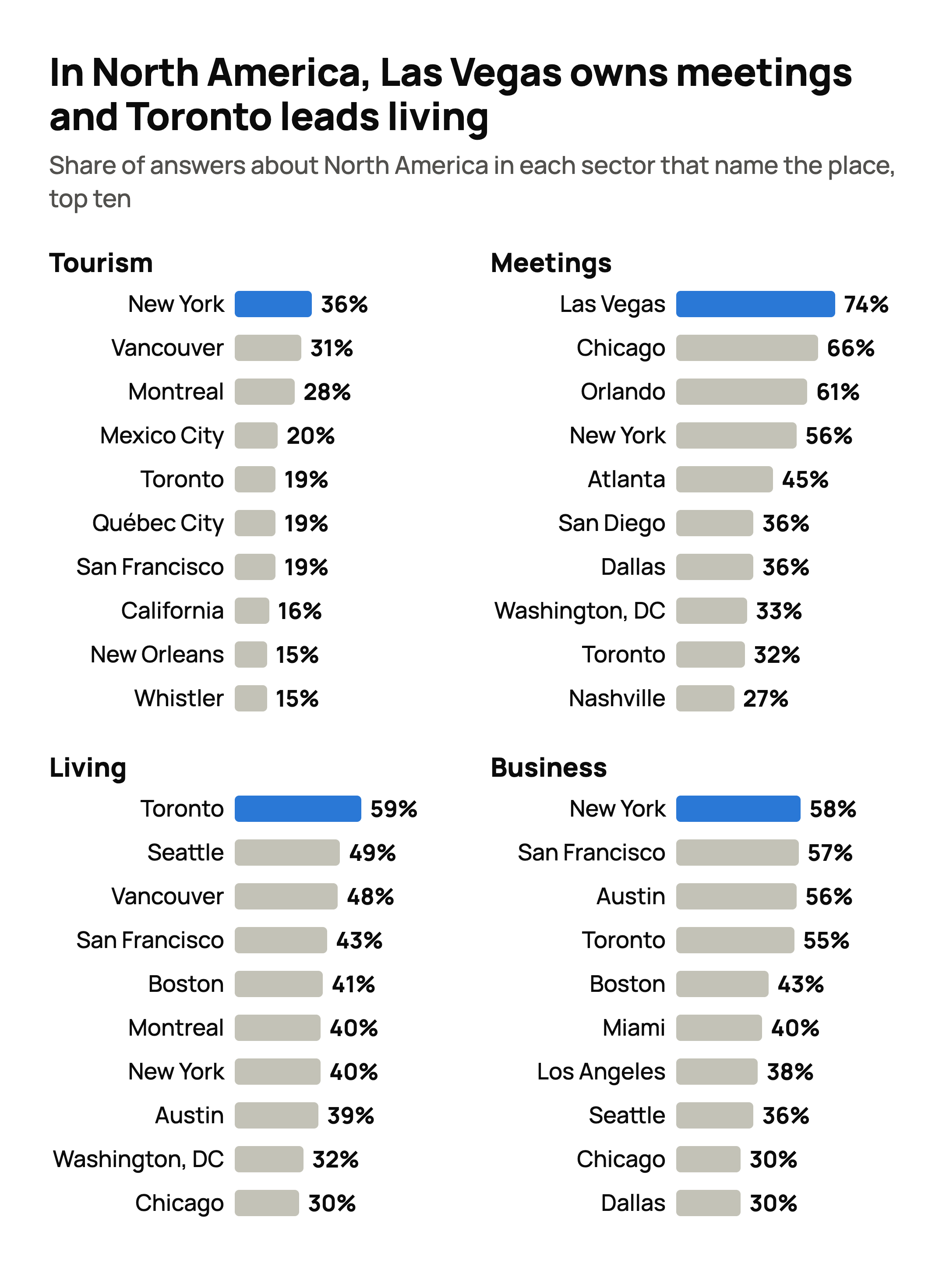
In North America, meetings is Las Vegas, in 74% of answers, then Chicago and Orlando. Living is Toronto, then Seattle and Vancouver. Business is a close race between New York, San Francisco, Austin and Toronto. For tourism, New York leads, and five of the top ten are in Canada: Vancouver, Montreal, Toronto, Québec City and Whistler.
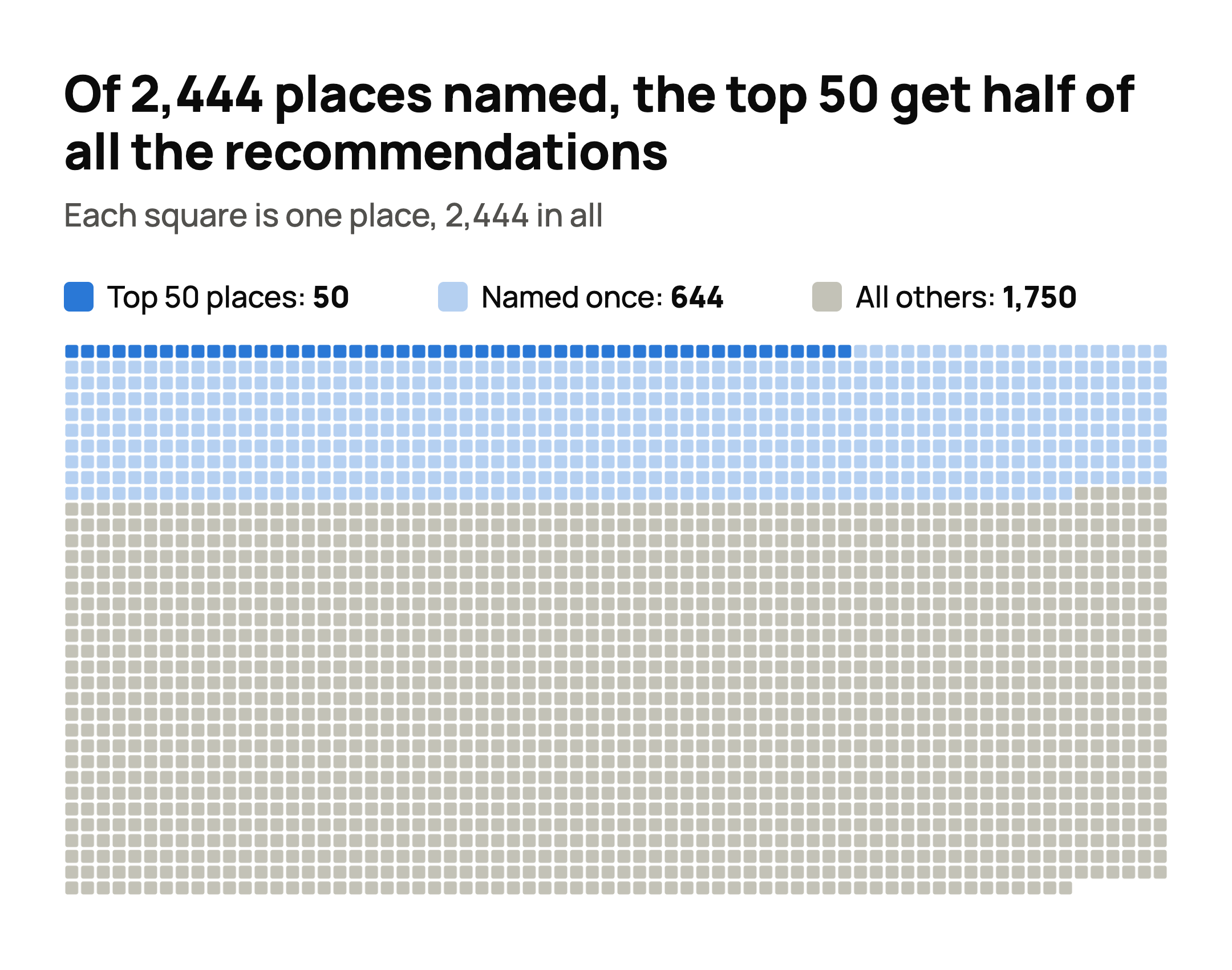
About 50 places get half of all the recommendations, and 644 places were named exactly once in 30,020 answers.
Smaller places can still win on specific questions. Bordeaux, for example, comes up almost entirely on one food and wine question. The big cities own the broad questions, and the niche questions are still wide open.
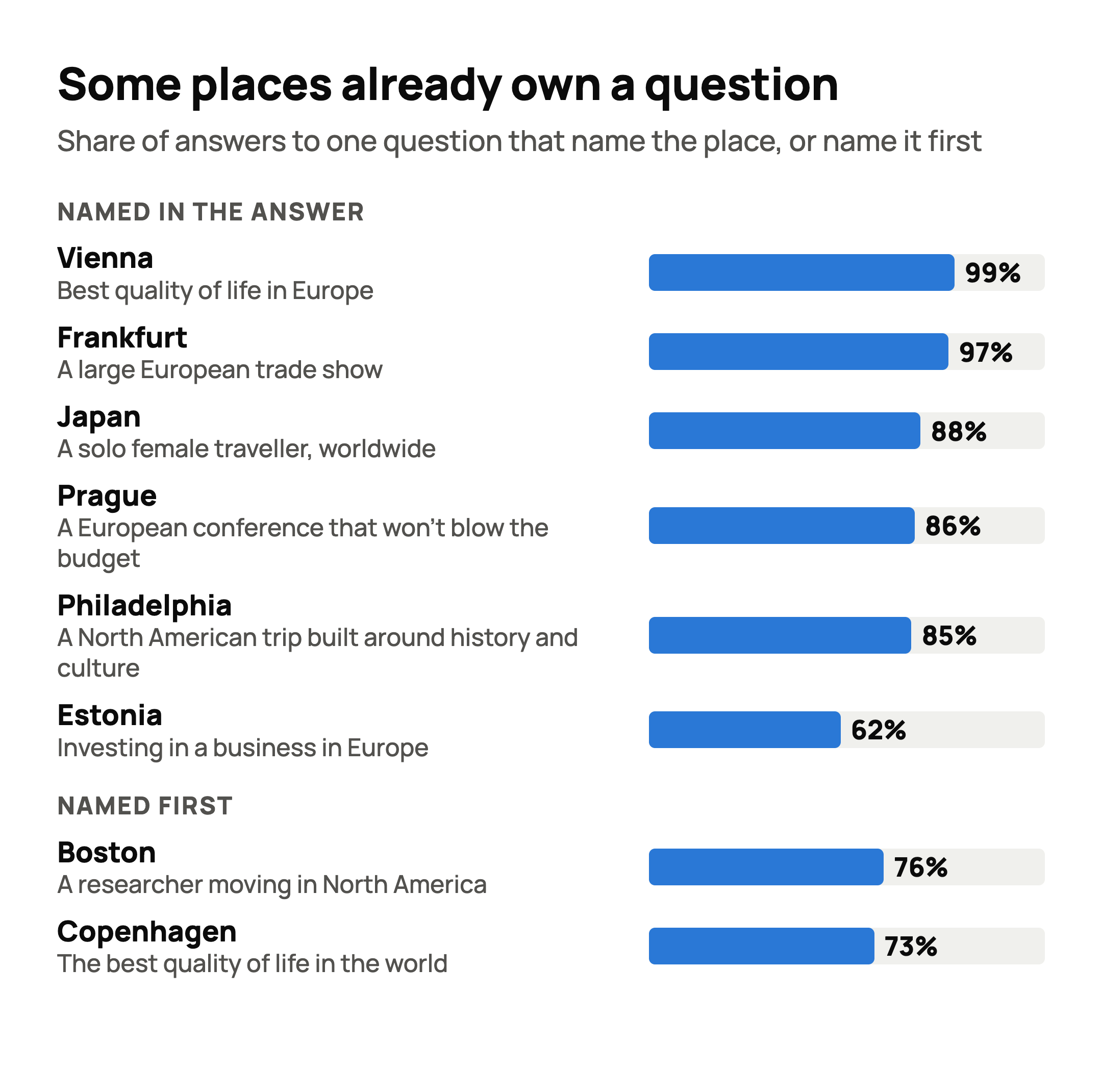
Each of these places is the default answer to a question its visitors, planners or investors actually ask. That’s what every destination should aim for, and it’s step three in the five moves below.
The three AIs don’t agree with each other. Ask all three the same question in the same week, and they name the same first choice only 22% of the time.
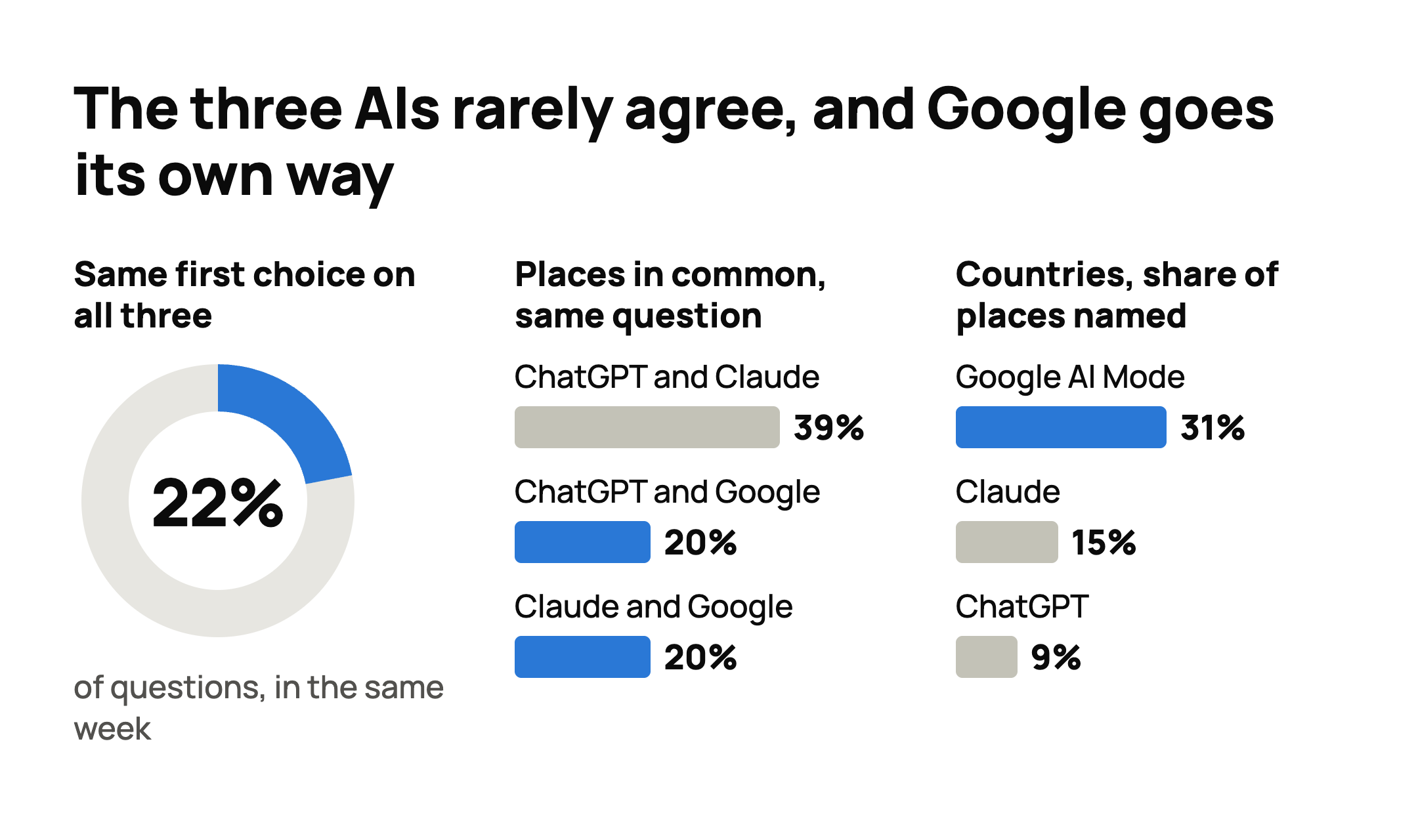
Google AI Mode is the most different of the three. On the same question, only about 20% of its places are also in ChatGPT’s answer, and the same is true for Claude’s. ChatGPT and Claude share 39%.
Google also thinks in countries far more than the other two. Countries are 31% of Google’s mentions, 15% of Claude’s and 9% of ChatGPT’s.
Each AI also has its favourites. ChatGPT names Vancouver in 16% of all its answers, while Google names it in 3%. (Full disclosure: I used to market Vancouver, so I like ChatGPT.)
Because the AIs disagree this much, a single score hides a lot. It pays to check how your destination shows up on each one separately, and the Index shows your results on each AI side by side.
The answers also change depending on where the person asking lives. We asked the same World questions from all ten home cities. Tell an AI you live in Johannesburg, and Cape Town’s share rises 39 points. From Mumbai, Dubai rises 28 points. From Tokyo, Seoul rises 25.
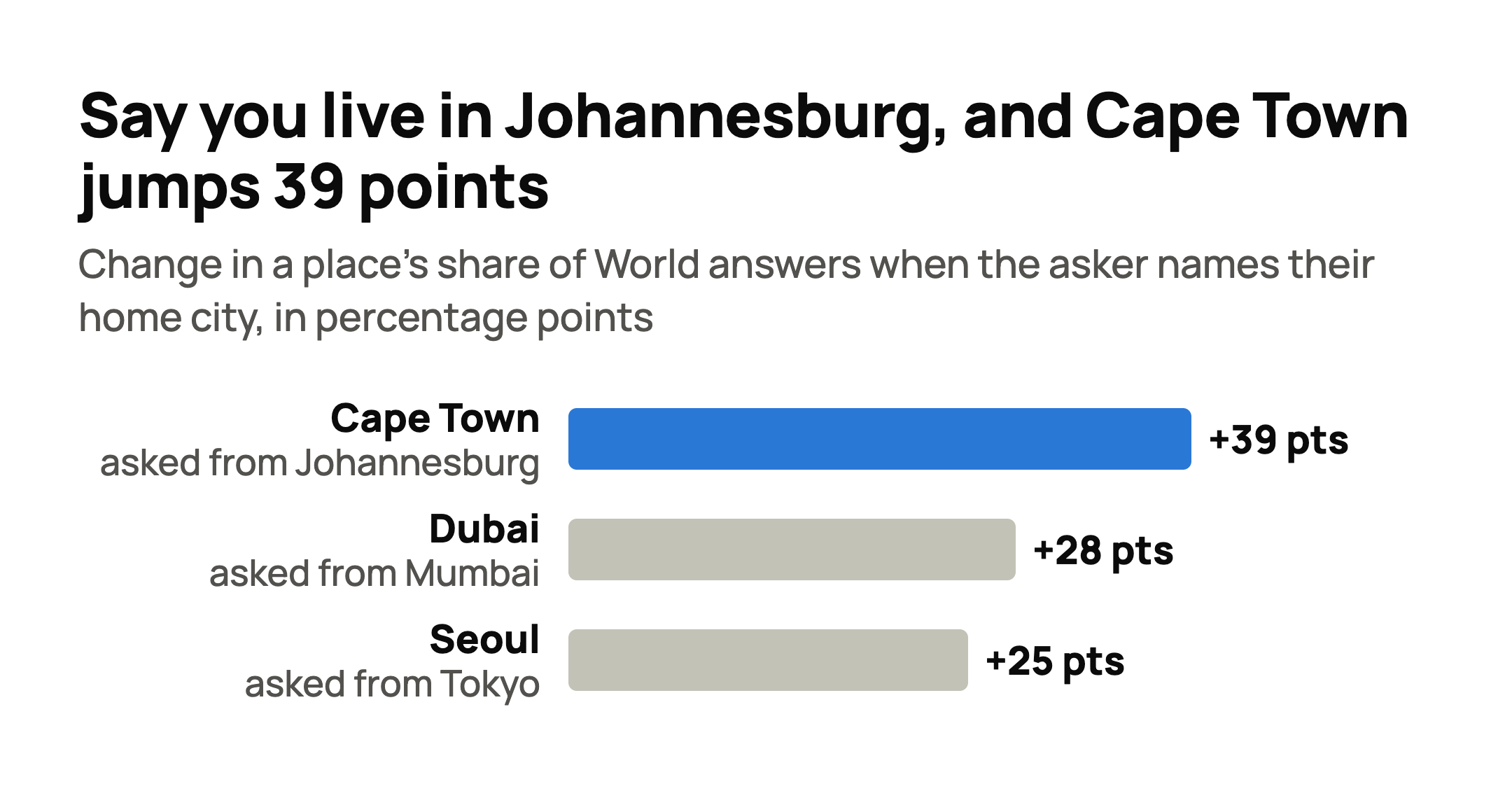
That means there’s no single AI ranking, and your visibility depends on where your visitors are asking from. In the Index, you can see how your destination’s answers change by home city.
And when the AI doesn’t know where you live, the AI’s default traveller looks American. With no home city, US places show up in two thirds of World answers, and those answers look most like what someone in New York gets. If your visitors come from Asia or Europe, the default view isn’t their view.
We also compared the AIs with the opinions of real people. Resonance’s World’s Best Cities survey, run with Ipsos in about 30 countries, asks people which cities they would most like to visit, which they would most like to live in, and where the best jobs are. We ranked the same 194 cities identified in our survey by how often the AIs name them.
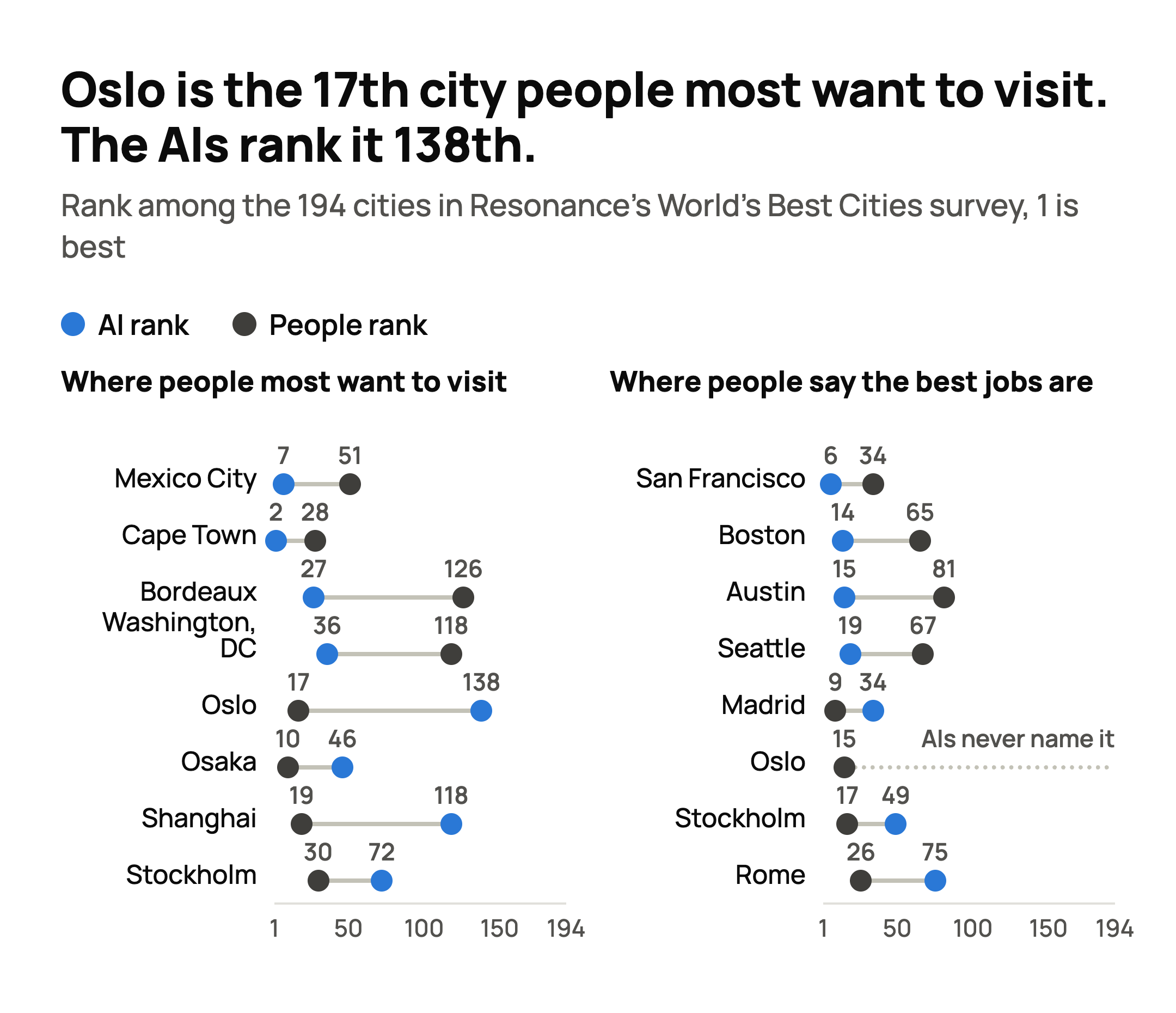
For tourism, the AIs rank Mexico City 7th, and people rank it 51st. Cape Town is 2nd with the AIs and 28th with people. Bordeaux is 27th against 126th, almost entirely from one food and wine question.
Some places rank much higher with people than with the AIs. Oslo is the 17th city people most want to visit, and the AIs rank it 138th. Osaka is 10th with people and 46th with the AIs. People want to go, and the AIs haven’t caught up yet.
On jobs, both lists put London, Singapore, New York and Tokyo on top. After that, funny enough, the AIs rank US tech cities much higher than people do. San Francisco is 6th with the AIs and 34th with people. Austin is 15th against 81st. And the AIs rank Madrid, Stockholm and Rome much lower. Oslo is 15th with people, and the AIs never name it.
All three AIs now search the web before they answer. And when you search for the best city to live in, or where to hold a conference, what comes back is mostly ranked lists. The AIs research the web, and the web answers with rankings.
The AIs repeat whoever publishes the list. For living, that’s Mercer and the Economist Intelligence Unit. Copenhagen ties Singapore as the AIs’ top city to live in worldwide, and Mercer is cited in 326 of Copenhagen’s answers. For business, it’s StartupBlink and Startup Genome. StartupBlink is in nearly half of ChatGPT’s and Claude’s business answers, and it’s in 516 of San Francisco’s 889. For meetings, it’s Cvent. It’s in 78% of ChatGPT’s meetings answers, and Las Vegas, Lisbon and Orlando ride on it.
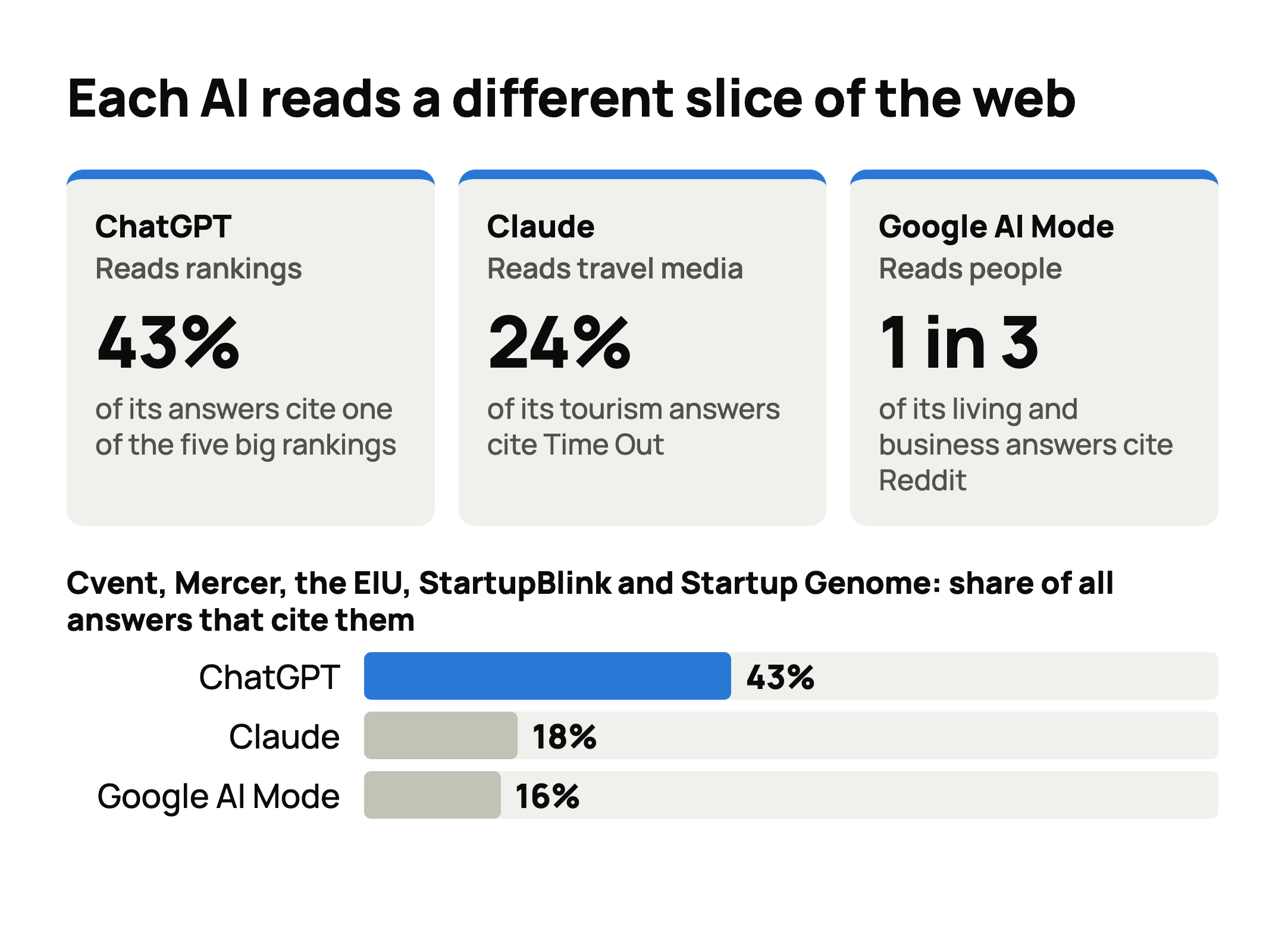
ChatGPT relies most on rankings. Those five lists show up in 43% of all its answers, more than twice as often as on Claude or Google.
Claude leans more on travel media. Time Out is in 24% of its tourism answers, and Forbes, Euronews and Wikipedia show up more in Claude than in the other two.
Google AI Mode leans on what people post. Reddit is in about a third of its living and business answers, and Facebook and YouTube follow the same pattern. ChatGPT and Claude together cited Reddit twice in 20,000 answers.
So the work to show up on Google looks different from the work to show up on ChatGPT.
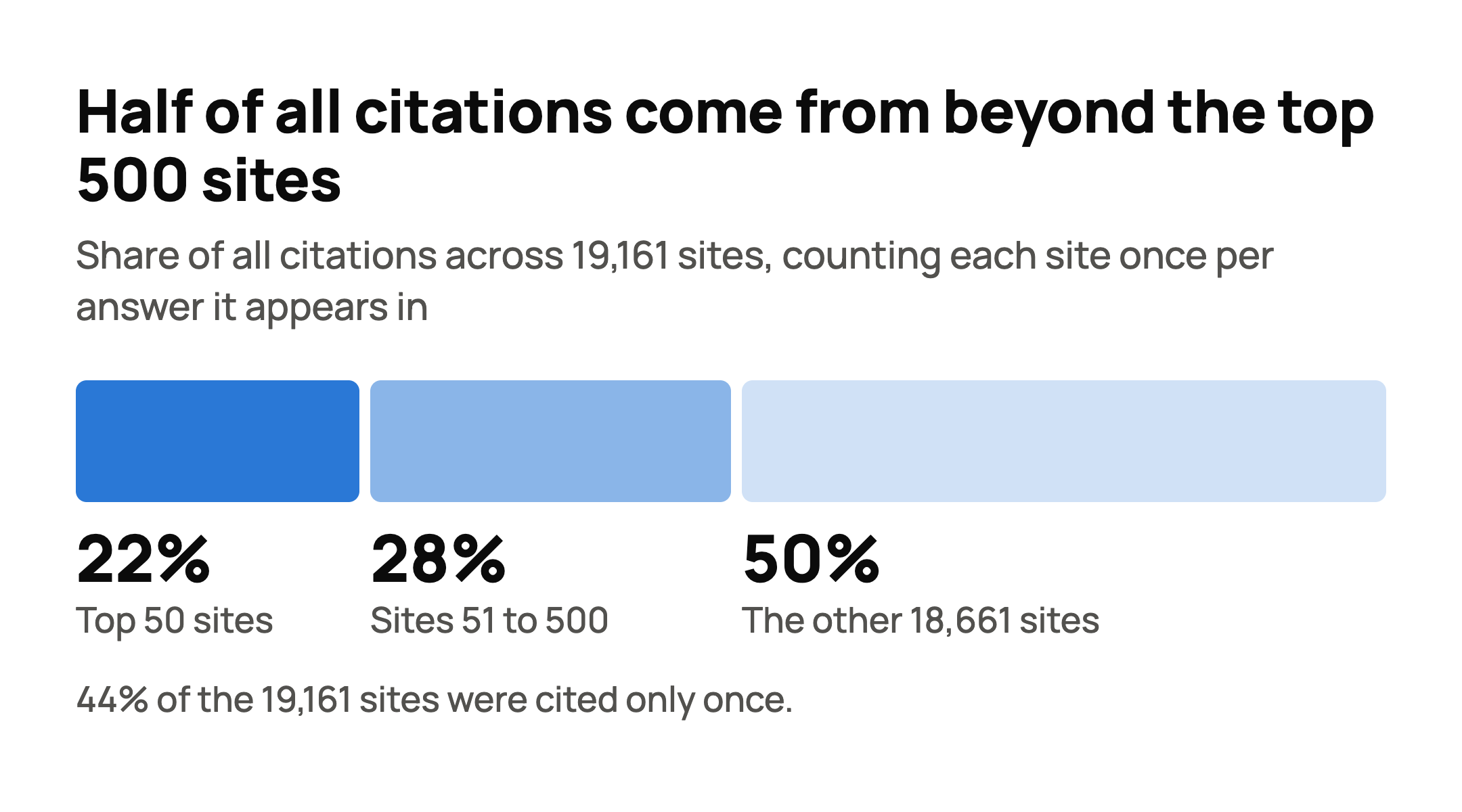
So the big names are only part of the picture. Half of all the AIs’ citations come from beyond the top 500 sites, and that long tail is full of local media, blogs and specialist titles, from the Japan Times, Khaleej Times and Vancouver’s CityNews to Wine Spectator, Ski Magazine and small travel blogs. That’s where it’s easier for a destination to make an impact. The Index shows you which sites the AIs cite for your destination.
The AIs also read research. Resonance’s World’s Best Cities is the 28th most cited source of the 19,161, in 625 answers, and all three AIs use it.
Every destination needs an AI visibility strategy. You can’t be the best at everything, and nobody has the budget to try. Here are five steps, in order, and most of them can start this quarter.
1. Know where you stand. Your score on each AI, from each market you sell to. What the AIs actually say about you, which is how they position you today. And the sources behind it.
2. Decide what you won’t chase. This is the core of any strategy. Pick the two or three things you want to be known for, and the questions that test them. Everything else comes off the plan, even questions you’d love to win.
3. Be the first answer for something specific. Prague, for example, is in 86% of answers for a European conference that won’t blow the budget.
4. Go after the big lists and the long tail. Work on the big sources each AI reads and change them as much as you can. ChatGPT relies most on rankings, like Cvent for meetings, Mercer for living and StartupBlink for business. Claude leans more on travel media, and Google leans on Reddit and YouTube, so give people something worth saying about you. Then go after the long tail. Half of all the AIs’ citations come from beyond the top 500 sites, and that’s where it’s easier to make an impact.
5. Measure, then adjust. Check your score every month, on each AI and from each market, and move your effort to what’s working.
Every place the AIs named is in the Index, including yours, and access is free. Search for your destination and see where it ranks on each board and on each AI, across all 2,444 places. You can read every question we asked, word for word, and the answers and sources behind them.
Would you like a two-page report on your destination? You can request one inside the Index, and we’ll put it together for you.
We’ll keep measuring how the AIs see the world, in every region and every sector, so you can track how your place moves. The America edition arrives early in 2027, built alongside Resonance’s America’s Best Cities.
Being recommended is the first step. The next is whether an AI agent can actually book you, and that’s moving fast. So we’re adding agent readiness to the Index. We’ll send the agents out to plan and book trips, and track who they pick and where they get stuck.
Question? Of course you have questions! Let’s chat: shawes@resonanceco.com
Stefan brings over 30 years of global marketing leadership to Resonance, where he leads the firm’s AI practice and helps shape marketing strategies for destinations, cities and developers. Combining deep brand strategy expertise with hands-on experience in AI, structured content and data systems, he helps places strengthen how they are discovered, described and recommended across an increasingly AI-driven landscape.
Similar Articles