Something big is happening (in place marketing, too)
19 February 2026
by Chris Fair, Resonance President & CEO

08 October 2026
by Stefan Hawes, Chief AI Officer & Senior VP Marketing, Resonance

In September 2026, I asked Meta’s new AI agent, Muse, to find my family and me something to do on the weekend.
It found a circus playing near me in Berlin. It found the tickets. It worked through the whole thing in German.
And then it fell over at the very last step, because it couldn’t process my card from Europe. (As of this writing, Muse is only available in the U.S. and Canada. I was using it through my Canadian account.)
Still, it got me 95% of the way there. And that’s pretty much where AI agents are right now.
Agents aren’t new. Tinkerers have been running their own since November 2025, when an open-source project now called OpenClaw let people hand an AI their email, their calendar and their errands. But you had to be the kind of person who was confident enough to look under the hood of your desktop, and didn’t mind the odd security scare.
September 2026 changed that. Meta launched Muse on September 8. It books flights, hotels and restaurants, and it passed 2.5 million downloads in two weeks.
Instinct, an invite-only agent you text like a friend, books everything from dinner to a last-minute trip, and says it’s on pace for about $1 billion a year in transactions, half of it travel. Google has been booking hotel rooms inside AI Mode in the U.S. since August 2026. And on September 29, OpenAI launched Dots, always-on agents with their own computer and browser that can book for you around the clock.
So the agents have started booking. The question for everyone in travel is whether they can book you. That goes for hotels, attractions and restaurants, and even for DMOs, some of which run their own booking engine.

The first thing to understand is that these agents don’t all work the same way.
Google is going in gently. Booking a room inside AI Mode is live today, but only for travelers in the U.S., and only with the big hospitality names Google has signed, including Marriott, IHG, Choice, Wyndham, Expedia and Booking.com. When a traveler books, the hotel or OTA stays the merchant of record, so it takes the payment and owns the booking. For every other hotel, it’s still coming. Google has published a draft of an open standard called the Universal Commerce Protocol, or UCP, which will let hotels plug in through their existing reservation systems. Google says it will move AI Mode hotel booking onto UCP over the coming months, but it hasn’t given a date. For now, other hotels can only join a waitlist.
Muse books in three ways: through partners, through websites and by phone. It books flights through Duffel, a service that connects to more than 500 airlines. It still books hotels by browsing sites the way a person would, and since September 22, 2026, it also books them through a partnership with Expedia. And when a business can’t be booked online, Muse can phone it on its user’s behalf. That’s been live for U.S. businesses since mid-September 2026, so a hotel’s front desk may already be taking calls from an AI. To complete transactions, Muse pays with a one-time card from Stripe, so the business never sees the traveler’s real card number.
Instinct, on the other hand, lives in its users’ text messages. There’s no app to download. People join a waitlist by text or get invited by someone already using it, then text or call it like a person. Most users just send it a voice note. “I need to be in New York tonight.” From there, it books the flight, the hotel and the ride to the airport, then updates the calendar. To get it done, it fills in booking forms on websites, and it has its own phone line to call businesses directly.
Then there’s Dots, OpenAI’s new agent tool. Each Dots agent gets its own computer and browser in OpenAI’s cloud, so it keeps working even when your computer is off. To make bookings, Dots agents work directly through websites. They come with ChatGPT’s Pro plans, which start at $100 a month.
Finally, Google has its own version, Gemini Spark, for paid subscribers almost everywhere except Europe. SpaceXAI’s Grok Bot works much the same way, and since late August 2026 it can buy things online in the U.S. once its user approves each charge. And Anthropic, which makes Claude, hasn’t launched a consumer booking agent yet, though Claude can already book business travel through Amex GBT. It seems like only a matter of time.
Put together, an agent can reach a business in three ways: through a partner, like Google’s hotel deals or Muse’s link to Expedia, through the business’s own website, or by phone. Most hotels and attractions won’t have a partner deal anytime soon, so the agents will mostly land on their own websites. That booking page has to work for a bot as well as a person.

The travel incumbents’ favorite argument against all of this is trust.
Glenn Fogel, CEO of Booking Holdings, was asked about Instinct at the Skift Global Forum in September 2026. “If we want to do Instinct, how hard do you think that would be?”
“It wouldn’t be that hard,” he said. “It’s not the creation of the technology that is the critical asset you have. It’s the trust.”
The surveys seem to back him up. Skift reported in March 2026 that only 2% of leisure travelers would let AI book a trip on its own. An Expedia survey put the share comfortable with AI handling bookings at 8%.
But those numbers are a snapshot, and attitudes like these can shift fast. Most of the people answering have never used an agent. And once they do, trust builds quickly. Instinct’s founder, Noah Shinn, tracks how quickly users hand over their credit card, and says 40% do it within three weeks. If you’re keeping track, that’s three weeks from being a stranger to having a credit card on file.
That matches my own experience. My trust in Claude built up gradually, one useful task at a time. By early 2026 it had earned enough trust for me to let it look over my tax return, and it found a mistake that both my tax software and I had missed, which saved me real money.
Today I trust it with a lot more: my inbox, my calendar, meal planning, real estate, investing, and even legal decisions. Booking my travel is simply the next step.
That’s how trust builds with any new assistant. First, the agent gets to know you, your family and your situation, because it’s connected to your email, your messages and your calendar. Then it gets the small things right. The groceries. The theater tickets. It saves you a bit of money along the way. One early Instinct user says it audited his subscriptions and saved him about $200 a year. And pretty soon you’re happy to let it book the family holiday.
Of course, things do go wrong. An Inc. columnist says Muse read private messages on his Mac that it hadn’t been given access to (Meta says that isn’t possible). Meta’s own help page says users are responsible for every purchase their Muse makes. My own Claude goes awry, too. It has sent emails for me after I’d asked it not to hit Send on its own, and recently signed me up for four phone plans when I only needed one.
None of that has stopped me, or anyone I know. When something goes wrong, you give the agent a new rule, like “never hit Send without asking me,” and keep going.
Fogel’s other argument is that travelers want someone to call when a trip goes wrong. Booking.com made the same case when I spoke alongside Google, Microsoft, Expedia and Agoda at an APEC workshop on AI and tourism in Korea in 2025. But when I need the confidence of a person backing me up, I’m more likely to go to the travel agent down the street than I am to an OTA. Hence the continued use of human agents to book complicated and important trips. And when my flight is canceled, I’m not convinced an OTA call center picks up and sorts me out right away.
An agent, on the other hand, doesn’t sit on hold. It already knows my trip and my loyalty numbers, and it can check every airline and every open seat at once, at three in the morning if it has to. In fact, Instinct can already rebook a trip and apply existing travel credits. If there’s a way onto the next flight in an emergency, my money is on the agent.
The knowledge that creates trust and makes agents so effective cuts both ways, though. Once my agent knows all about me, switching to another one gets expensive if I have to start over. And each of them handles their knowledge of their users differently. For example, Muse trains on your data by default and lets you edit what it remembers, while Dots can’t yet delete individual memories. And if a small agent company gets bought, everything it knows about me goes with it. Airlines and hotels will recognize the pattern. It’s exactly what their loyalty programs were built to do, but now the agent is the one holding the relationship.
And once a traveler trusts their agent, the agent is the one making the decisions, including where to book. If it can’t book your business, it’ll probably book somewhere else.

On September 20, Amazon blocked Muse from shopping on its site.
It’s easy to see why. Amazon made a fortune from advertising in 2025 ($68 billion!). And yet I’ve always been amazed at how cluttered and difficult Amazon’s search is. I recently needed to buy a size 5 basketball. How is it that a search for size 5 basketballs doesn’t only serve up size 5 basketballs? But a cluttered search page is good business when every scroll is ad space. An agent that goes straight to the right ball never sees a single sponsored listing. It skips all of it.
In booking travel, Muse has its own version of this problem. It books its hotels through Expedia. But even people who book on Expedia have always shopped around, because they want to know they got the best deal. They’ll expect their agent to do that shopping for them. If my agent only ever shows me one website’s prices, I start to wonder who it’s really working for. If it looks around, I trust that it’s finding me the best value. An agent that starts by saving you money earns the right to spend it.
Agents will have their own money pressures too. Instinct is free today, but Shinn says he’s weighing a fee on merchants of anywhere from 2.5% to 30%. One would expect merchants to pass that on to customers in their prices. To his credit, Shinn sees the risk: “it would be a very dangerous world if [Instinct] were influencing the user’s behavior to purchase something that they don’t want to purchase.”
As for Google, it hasn’t said much yet about how it will make money from all of this. My guess is something like Apple’s App Store, a cut of every transaction.
If that’s where it goes, the math changes for everyone. A hotel that used to get a booking straight from its own website, for free, would now pay a small cut to the agent’s company. A hotel that used to hand an OTA 15% or more might end up paying less as traffic is diverted. Some will come out ahead and some won’t. Google says AI Mode results aren’t influenced by advertising today, and a flat cut on every booking shouldn’t bias anything. But search ads have paid for almost everything Google does. Booking and Expedia are among Google’s biggest advertisers, and Booking alone has paid Google more than $1 billion in a single quarter.
Google isn’t in the business of killing its own business. If travelers let an agent book for them instead, that money has to come from somewhere else, and it’s worth watching whether anyone ends up paying for a better spot.
Right now there are two models side by side. Muse is free for travelers, and Meta plans to take a small fee from the merchants it has partnered with, like Expedia. For now, Meta and Instinct are happy to give their agents away to win users and prove the model works, and they’ll sort out the money later. There’s an old line about free social media: if you’re not paying for the product, you are the product. Dots works the other way around. It comes with a ChatGPT Pro plan that starts at $100 a month. OpenAI does sell ads in ChatGPT now, but only on its free and cheapest plans, so nobody is paying OpenAI to steer the people using Dots. If I’m paying for an agent, I’d expect it to stay on my side at all times, only ever working in my best interests, and I’ll happily pay for that.
This probably won’t settle anytime soon. The giants that already have our trust, Google, Apple, OpenAI, Anthropic and maybe Meta, will fight it out with upstarts like Instinct, and some of those upstarts will get bought along the way.
Hotels want direct bookings. They’re also nervous about Google sitting between them and their most loyal guests. I’ve heard that concern directly from the marketing head of a major hotel chain.
And you can see why. The big chains have spent years and huge sums building their loyalty programs so their best guests come straight to them. Now an agent is potentially stepping in between the hotel and the guest it worked so hard to keep.
Hotels also want guests in their own apps, and they’ll offer real benefits to get them there. But that runs against what agents offer. As a traveler, I want one tool that does it all for me, one that already knows everything about me, rather than a separate app for every hotel chain.
But booking a hotel directly through Google is still booking direct. In AI Mode the hotel is the merchant, it gets the guest and the guest’s details, and the guest earns their points. And the chains are already signing on. Hilton, Wyndham and Choice guests can earn and use their points inside AI Mode, with Hyatt and others on the way.
That could be good news for hotels. Travelers likely won’t see much value in going from Google to Expedia to the hotel when an agent can compare prices and go straight to the hotel. Every one of those bookings is one the hotel doesn’t pay an OTA 15% or more for. At the smaller end, Shinn says some boutique hotels are already offering agents up to 30% of every booking they deliver.
That sounds like a lot until you think about where those hotels sit. An independent boutique hotel doesn’t have a global brand or a loyalty program pulling guests in. It already hands an OTA a hefty commission on most of its bookings, and it gets very little say in how it’s presented. An agent that brings it a guest who knows what they want, books on the spot and might well come back is worth paying for. Shinn himself says Instinct won’t necessarily charge 30%. But hotels have already shown what they’d be willing to pay.
The rest of the travel ecosystem is a patchwork for agents.
Muse, Instinct and Dots can book flights. Google can’t yet. Restaurants are further along. All of the agents already book them. Google has offered table bookings in AI Mode in the U.S. since August 2025 and in the UK since April 2026, the others book online, and when a restaurant doesn’t take online bookings, Muse and Instinct simply call. Tours and attractions are opening up too. Viator and GetYourGuide can now be booked inside Gemini, and GetYourGuide also works inside ChatGPT. Beyond those two, tours and attractions can only be reached by the agents that work through a browser.
That last part is good news for small operators. You don’t need a deal with Google or Meta. You need a booking page a bot can actually finish.
Which brings me to basketball. Last week I asked Muse to buy tickets for an ALBA Berlin women’s game. Everything went well until the ticket site asked it to prove it was human, where it told me it needed my help. Agents don’t all handle these checks the same way, and the rules keep changing. In July 2025, OpenAI’s ChatGPT agent was caught clicking straight through an “I am not a robot” check. Muse will do almost anything to get a booking through, but it stopped there and wouldn’t pretend to be human, and I like that. I get why the site has the test – we all hate scalpers. At the same time, it also blocked a perfectly legitimate purchase for that business. Now, I ended up going online and buying those tickets myself (Go Alba!), but as we rely more on agents I believe we’ll see less openness to intervene.
Ticket sites and booking engines need a better test than “prove you’re human,” because more and more legitimate buyers are going to be bots. Visa and Mastercard are already building ways for a website to recognize a trusted agent and tell it apart from a scalper’s bot. For the most part, ticketing hasn’t caught up yet and, until it does, it’ll keep turning away paying customers.
European readers may have noticed something. You can’t use most of this. Muse is only in the U.S. and Canada. Google’s hotel booking in AI Mode is U.S. only. Dots and Gemini Spark aren’t available to consumers in the EU, the UK or Switzerland, and Apple’s new Siri isn’t on iPhones in the EU. The reasons range from EU competition rules to privacy legislation, and most of these companies haven’t given a date for European rollout. So for now, the travelers using agents to book trips to Europe will mostly be Americans and Canadians.
Either way, visibility still comes first for DMOs. You need to be near the top of the list when someone asks an AI where to go. But being found is now only half the job. Once a traveler discovers you, the thing they just found has to be bookable.
That’s where DMOs come in. As agents start planning whole trips, they’ll likely lean toward the hotels, tours and restaurants they can actually book. Local businesses already look to their DMO to explain changes like this. DMOs don’t have a cash register of their own, and most don’t feel they have the resources to spare. But they are in a leadership role: they can test the agents, learn, show their industry where this is going and help their partners get bookable.
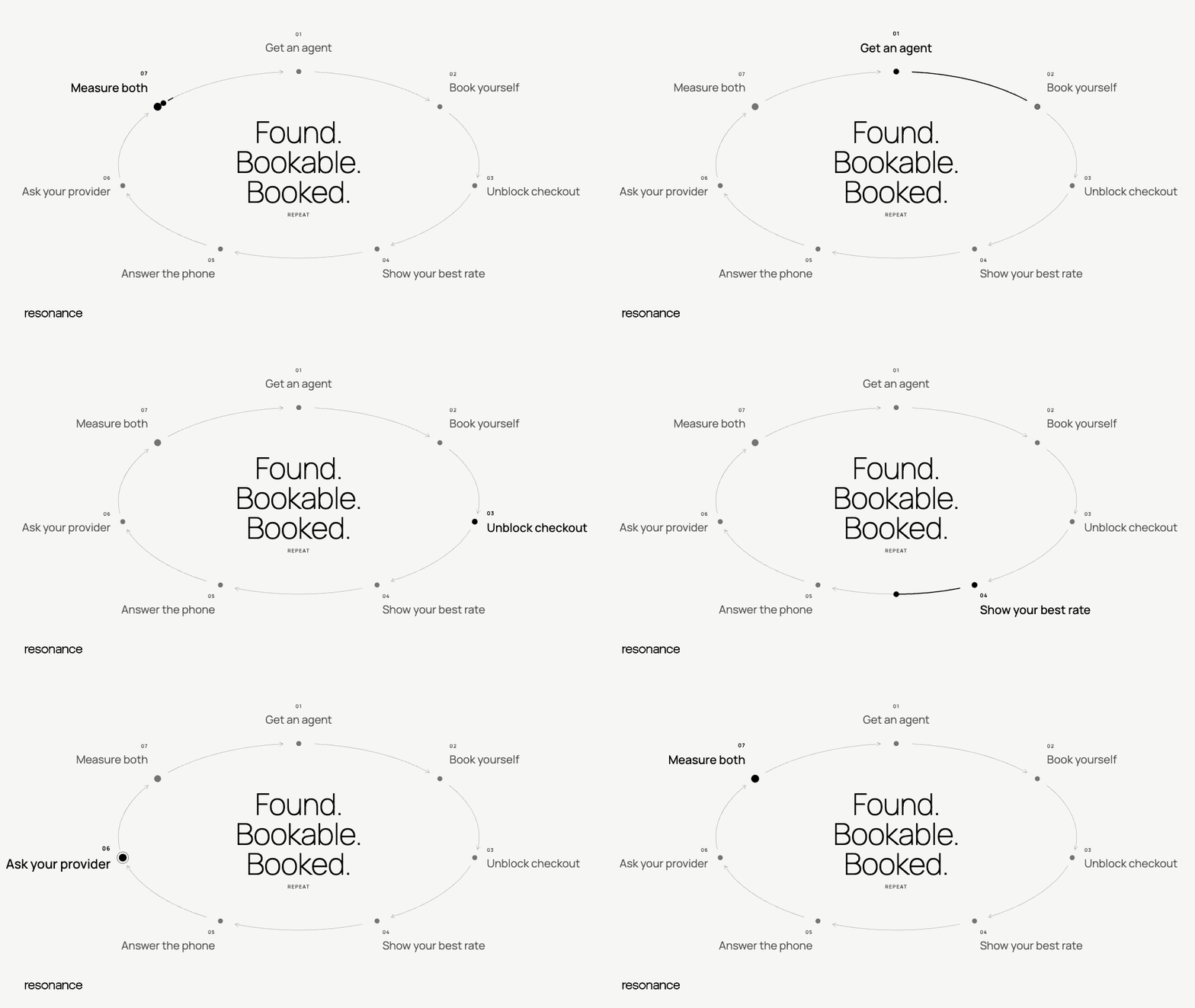
The good news is that getting ready doesn’t need a big budget or a new tech stack. Whether you run a hotel, an attraction, a tour or a destination, here’s where we’d start. Most of it can happen this quarter.
1. Sign up. Get an agent of your own, whether that’s Muse, Dots, or Instinct if you can find an invite. Connect it to whatever you feel comfortable with, and use it for a few weeks. It’s hard to plan for how your guests will use agents until you’ve lived with one yourself.
2. Try to book yourself. Ask an agent to book your hotel, your attraction or a weekend in your destination, and watch where it gets stuck. That’s the fastest way to see what your guests are about to run into.
3. Make sure a bot can finish your booking. Many booking engines block agents without anyone realizing it. If an agent can’t get to the confirmation page, you don’t get the booking.
4. Make your pricing make sense to a machine. Many hotels price differently by channel and offer member rates for booking direct. But agents compare every channel in seconds. If your rate is better, make sure an agent can see it and see why. If it can’t, it books somewhere else.
5. Answer the phone. Instinct and Muse are already calling businesses on their users’ behalf. What happens when they call your phone number? We might all have to get better at answering the phone, or get our own agents to answer it for us.
6. Ask your technology provider what they’re doing about agents. Your booking, reservation or ticketing system is the most likely route onto Google’s UCP and other agent connections, so it’s worth asking now where they are with it.
7. Measure being found and being bookable together. AI visibility still comes first. If an AI doesn’t recommend you, its agent never comes looking, which is why we run AI visibility audits that show how often you’re recommended and where you’re falling short. Being bookable is the second half of the equation. A recommendation is worth a lot less if the agent can’t complete the sale once it gets there.
Everything above is about right now. But this is moving fast. In October 2025, OpenClaw didn’t exist, and the agents we’ve talked about here are a tiny taste of what we’ll see in the next six months. The details in this article will date quickly, but the principles won’t.
The bigger question is what happens to your business when every customer, and everyone on your team, has an agent working for them around the clock.
It’s already starting. In New York, diners are setting their agents loose on Resy to grab tables at hard-to-book spots like 4 Charles Prime Rib. One investor’s Instinct agent checked Resy hundreds of times an hour until Resy locked his account. Agents are also starting to talk to each other. Skift described a group of six planning a weekend, with their agents sorting out the dates and routing everyone into a single Uber.
Put those together and picture a hotel a little further out. The guest’s agent negotiates a late checkout with the hotel’s agent, while the front desk team uses agents of their own to answer calls, shuffle room assignments and handle requests from dozens of other guests’ agents. That’s a swarm of agents needing service, and no operator is set up for it yet.
The OTAs, the hotel chains and the destinations are all still working this out, and if we’re honest, so are the AI companies. That’s okay. But the time to start planning is now, while the agents are still new and the rules are still being written. The businesses that start testing, fixing and thinking this through today are the ones their guests’ agents will find first.
Let’s get started making the agents work for us. Need help? Let’s talk.
Stefan brings over 30 years of global marketing leadership to Resonance, where he leads the firm’s AI practice and helps shape marketing strategies for destinations, cities and developers. Combining deep brand strategy expertise with hands-on experience in AI, structured content and data systems, he helps places strengthen how they are discovered, described and recommended across an increasingly AI-driven landscape.
Similar Articles
19 February 2026
by Chris Fair, Resonance President & CEO
14 May 2026
by Chris Fair, President & CEO, Resonance Consultancy