What do the wealthiest U.S. travelers want from you?
22 January 2026
by Chris Fair, Resonance President & CEO

17 September 2026
by Chris Fair, President & CEO, Resonance Consultancy

Get your free copy of our Future of Luxury Travel Report.
Last month Aman opened its first Mexico resort, Amanvari, on a quiet stretch of Baja California’s East Cape. It has just 18 casitas. Opening rates start around $3,000 a night in low season and climb past $6,000 at peak – with no room type, no entry-level category, and no discount tier below that number.
Resonance developed the Amanvari identity and branding so I’ve watched the development of this property closely. What’s notable isn’t that Aman can charge four figures a night – Aman has always commanded a premium. It’s that demand is showing up at that price point, at scale, for a brand-new property in a relatively remote location on the East Cape of Los Cabos that most travelers couldn’t find on a map a few years ago. That is not a coincidence of timing. It’s a leading indicator of where travel demand is actually headed.
For more insights on the Top 10%, you can download our free Future of Luxury Travel report here.
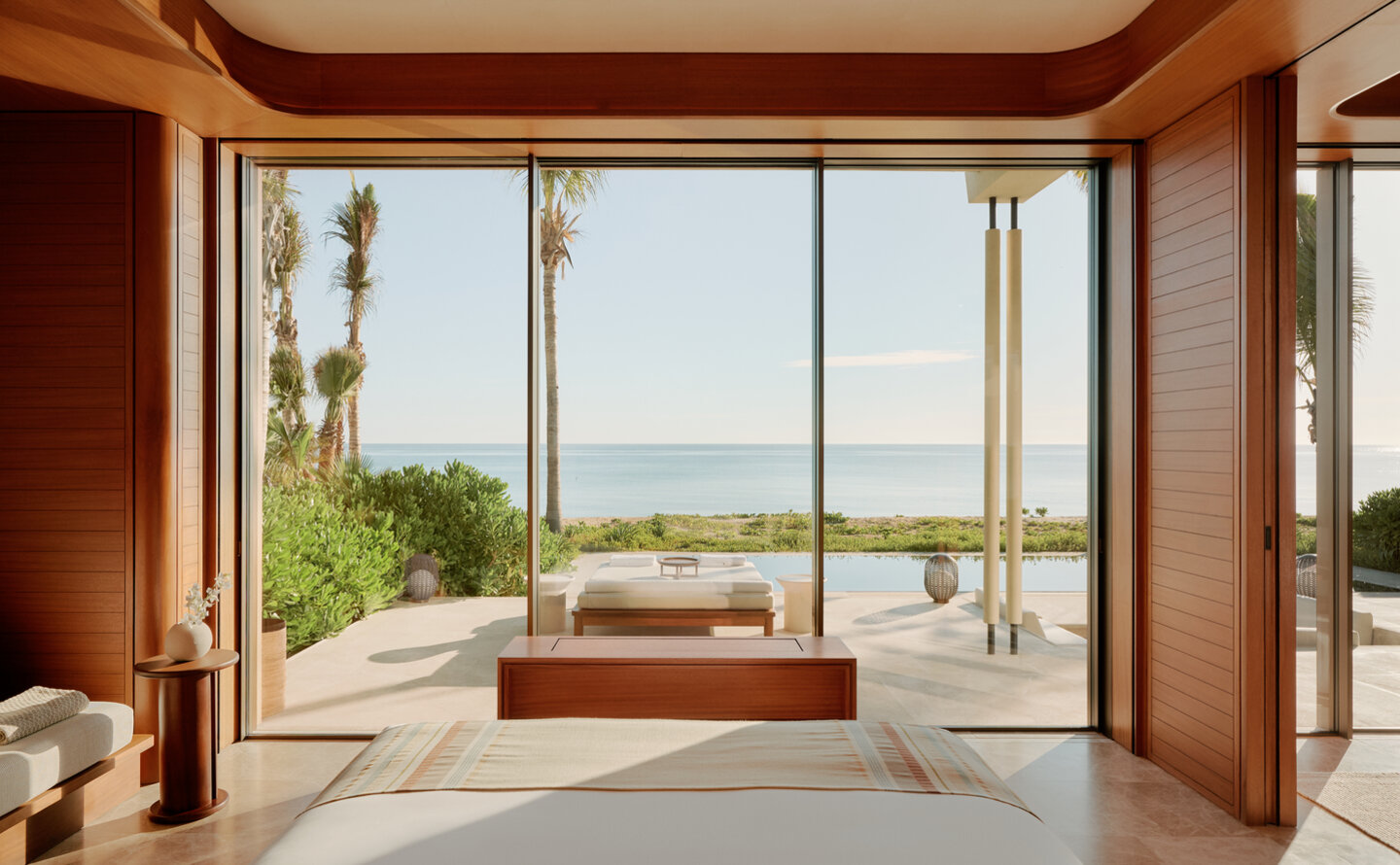
Resonance client Amanvari Resort and Residences
For a generation, the travel and hospitality industry has planned around the middle.
Destination strategy, hotel development pipelines, airline fleet orders – nearly all of it assumed a broad base of travelers moving steadily up-market as incomes rose. But that’s no longer the case.
The top 10% of U.S. households (HHI $240k+) now account for nearly 50% of all U.S. consumer spending, and our own research at Resonance estimates that the same top decile accounts for 54% of U.S. leisure travel spending specifically.
That figure tracks a wider pattern that economists now call the K-shaped economy: one branch pulling up, the other down, and the middle thinning.
What that thinning middle actually means for the travel industry is not that fewer people are traveling. It’s that two increasingly distinct tourism economies are forming inside the same market. One is populated by affluent travelers who show little resistance to rising rates and are, if anything, rewarding scarcity and exclusivity with more spending. The other is a growing population of value-oriented travelers for whom inflation continues to outstrip wage growth, who are not disappearing from travel but are becoming sharper, more price-sensitive shoppers within it.
Destinations, hotel brands and airlines built around a single “average” traveler sitting between those two groups are the ones with the most to lose.

Resonance's Future of Luxury Travel Report is free and packed with luxury travel data and forecasts.
The K-shaped pattern is no longer a media narrative. It shows up consistently across independent sources, several of them specific to travel.
Moody’s Analytics put the top 10% of earners at 49.2% of all U.S. consumer spending in the second quarter of 2025, up from 48.5% the prior quarter, about 46% in 2023 and roughly 36% if you went all the way back to the 1990s. The Federal Reserve Bank of New York reached a compatible finding through different data, concluding that retail spending growth since 2023 has been driven by households earning more than $125,000.
Hotels provide the cleanest sector read. CoStar and Tourism Economics report households earning $200,000 or more account for 25% of all travel spending while making up 11% of households, and forecast double-digit RevPAR growth for luxury chains in both the second and third quarters of 2026, lifting full-year luxury ADR growth to 5.9%.
Airlines also make the point vividly. Delta’s premium revenue passed main cabin revenue for the first time in company history in the fourth quarter of 2025, at $5.7 billion against $5.62 billion, and the gap widened by the second quarter of 2026 to $6.92 billion against $6.85 billion. United and American have both reported premium demand and capacity growth outpacing standard economy.

Spending by U.S. travelers on international travel is up 88% since 2019.
While the number of trips taken internationally by U.S. travelers has grown by about 8% since 2019, spending is up 88%, with U.S. travelers spending a record $260 billion on international travel in 2025.
And it’s this spending, not the trip count, that should interest destination leaders. Americans in Spain spent close to $350 a day last year, against roughly $200 for German visitors and about $150 for French ones. In Greece they stayed nine nights on average, compared with seven for British travelers. More than 15% of Americans visiting Europe reported household income of $300,000 or more, and luxury research firm Bernstein estimates U.S. tourists account for about 15% of all European luxury sales.
This is beginning to distort local tourism economies rather than simply lift them. Barcelona received nine times as many tourists last year as it has residents. Protests over crowding have spread to hot spots in Italy and Portugal, and governments across the continent are moving to cap tourism directly by restricting Airbnb listings, taxing visitors, and limiting cruise arrivals and new hotel construction.
Those same governments face a genuine Catch-22, because the American visitor is simultaneously the most disruptive and the most commercially necessary. A destination economy that needs the spending of its most affluent visitors while its residents push back on the crowding and cost pressure those visitors bring is the closest thing available to a live preview of what a K-weighted visitor economy does to a place.

Plan for two travelers. Do not plan for one to disappear.
But this is not a tidy story of “luxury wins, everything else loses.” Our colleague Jan Freitag from STR told the NYU International Hotel Investment Forum in June that the industry is now seeing widespread demand growth in the middle of the chain scale – upscale, upper midscale and midscale – a reversal from recent years when growth concentrated in luxury and upper upscale.
CoStar’s August note arrives at the same place from the other direction: midscale and economy RevPAR growth is coming primarily from demand, with rate the constrained variable. Demand at the bottom of the K is growing. Pricing power is what is missing.
Then there is the wage data.
The Bank of America Institute found after-tax wage growth for lower-income households accelerated to 4.1% in June from 2.9% in May, against 4.2% for higher-income households – the narrowest spread in years.
Treasury Secretary Scott Bessent has gone so far as to declare the K-shaped economy over, pointing to this convergence as evidence the divide is closing. Bank of America cautions that some of the acceleration may be mechanical, driven by withholding changes rather than underlying pay, which is exactly why the next two quarters of that series matter more than any single travel forecast – and why I’d treat “the K is over” as premature.
Wage convergence, if it holds, would narrow the gap between the two tourism economies described above. It would not erase it. Even in Bank of America’s own data, the top 5% of earners continue to outspend everyone else, and nothing in the airline or hotel data shows affluent travelers pulling back.
Personally, I think the K in travel is a yield and pricing story much more than a volume story, and a meaningful share of it has been manufactured by supply decisions at airlines and hotel companies rather than revealed by consumer behavior.
Destinations that read a premium-tilted revenue mix as evidence of collapsing mid-market demand will over-rotate, over-invest at the top, and get caught if the wage convergence holds.
Plan for two travelers. Do not plan for one to disappear.

For DMOs, visitor spend per capita, average daily rate and length of stay are the numbers that describe what is actually happening.
The practical challenge for every destination leader reading this is that these two tourism economies don’t just require different marketing messages. They require different products, different infrastructure, and different definitions of success. What follows is less a single strategy than a set of decisions destinations need to make on both sides of the K at once.
Yield belongs at the center of the scorecard. If growth concentrates by income, arrivals counts stop describing anything useful. A destination can hold visitation flat and grow spending sharply, or grow arrivals into a revenue plateau. Visitor spend per capita, average daily rate and length of stay are the numbers that describe what is actually happening, and marketing investment should follow the channels and audiences that reach higher-yield travelers rather than optimizing for arrivals. For destinations acting inside the next 12 months, that means premium air access and route development, upper-upscale and luxury hotel investment, high-value experience and cultural product, and communications aimed at affluent-travel media.
But attracting affluent travelers is about more than just assets. The quality of experiences and service within the destination become more important than ever. A destination can land premium air service and a luxury hotel flag while its restaurants, retail, cultural programming and ground transportation stay resolutely mid-market. Affluent visitors then arrive and spend less than the asset base assumed they would. Airlines and hotel brands move first because they have the balance sheets to move first. Independent restaurants, museums and transport operators need a deliberate plan to keep pace, and in most markets that plan does not exist.
Then there is the exposure question, which gets the least attention and deserves the most. Drive markets, mid-tier convention cities and family-travel economies built their workforce and small-business base around volume visitation. If the middle really is thinning, that is a labor and small-business resilience problem before it is a marketing problem. It shows up as hospitality wage pressure, as independent operators unable to refinance, as convention hotels underperforming their room blocks. Very few destinations have run an honest exposure assessment on this – how much of the local visitor economy sits on the wrong branch of the K, which employers are most fragile, and what a mid-market softening would cost in jobs.
The key is to diversify by building for both economies rather than picking one. A destination that becomes fully dependent on high-spending travelers is exposed to a sharper downturn than one carrying a mixed portfolio. The work is to invest in luxury growth while holding the infrastructure, marketing and partnerships that keep the value-oriented economy healthy in its own right – including maintaining mid-market hotel supply and value-oriented campaigns, which for the moment are swimming against the current – so that a shock to high-income spending does not take the whole visitor economy with it. Two years from now the scarce asset just may be the destination that never stopped courting the middle.
But building new mid-scale accommodation supply is going to be challenging. HVS’s 2026 survey puts limited-service and midscale extended-stay construction at a median of $170,000 to $197,000 per key – costs that have held roughly flat while rate growth for that tier stays capped by consumer financial pressure, so the spread between the two no longer clears a return hurdle at current debt pricing. That math doesn’t kill demand for midscale rooms; it kills new construction of them. The properties that will still get built are the ones with a business case beyond leisure rate alone – near a hospital system, a university, a corporate campus, or a demand generator with contracted room-night volume that isn’t dependent on discretionary consumer spending. Everywhere else, growth is shifting from new construction to conversion of existing stock, which is a slower, more expensive way to add rooms. For a destination, this means the new supply that shows up will increasingly follow business and institutional demand rather than population growth or leisure appeal – and any destination counting on new midscale hotel rooms to serve its convention delegates, youth sports tournaments, and drive-market families should assume that supply arrives more slowly, and in fewer places, than it has historically.

DMOs consistently underrate cruise and all-inclusive products as competition.
There is a natural follow-up for destination marketers. If midscale supply stalls and resort pricing climbs toward Amanvari territory, do cities become more exclusive too, or relatively more attractive to travelers priced out of resorts? Both are happening, and which applies depends heavily on the type of city.
In supply-constrained gateway markets, land economics pull the whole stack upmarket together. New York, San Francisco and Chicago cannot add rooms quickly, and that scarcity lifts more than the luxury tier. Developers in land-constrained urban markets have been building smaller rooms paired with elevated design and generous public space, raising density per square foot and supporting premium pricing. It’s the same move luxury apartment development made a decade earlier.
Secondary and tertiary cities with intact midscale stock have the opposite opportunity. As resort and vacation pricing climbs, urban midscale product becomes a substitute rather than a downgrade, which caps rate growth across resort markets even as trophy properties that function as destinations in their own right hold their pricing power. Mid-tier resort destinations may be losing leisure share to cities with healthy midscale stock while the Amanvaris of the world keep commanding whatever they ask.
Cruise and all-inclusive product is the third lane, and DMOs consistently underrate it as competition. Cruise lines have leaned hard into a value and simplicity pitch, and part of that advantage is structural rather than promotional: one crew serves lodging, dining, entertainment and transport together instead of each being staffed and priced separately. A traveler who once booked a mid-tier beach resort now has a well-marketed alternative with a different cost structure. A city marketing itself as the affordable option against an expensive resort is competing with Royal Caribbean’s pricing model, and Royal Caribbean usually nails that pitch more convincingly.
The practical implication runs through an honest read of a city’s own supply constraints. Gateway cities should expect a more exclusive visitor profile across every price tier and can position accordingly. Cities with room to grow midscale supply have a real opening to market themselves as the value-conscious alternative, provided they understand who they are actually bidding against.

A strategy built for the “average” traveler is the one strategy guaranteed to serve neither.
Everything above points to the same conclusion for anyone running a destination, a DMO board, or a hotel portfolio: we are no longer serving one tourism economy. We are serving two: one built around affluent travelers who show little resistance to rising rates, and one increasingly defined by value-oriented travelers and the businesses that depend on them, for whom inflation continues to outstrip wage growth. Both are real. And both are growing in their own way.
A strategy built for the “average” traveler sitting between them is the one strategy guaranteed to serve neither – lacking distinct value and too plain for the affluent traveler, too polished and too pricey for the value-conscious one, and squeezed from both sides at once. Amanvari didn’t get built because Baja lost its budget travelers. It got built because someone stopped trying to serve everyone with the same product and built specifically, unapologetically, for one branch of the K.
The right response isn’t to pick a side. It’s to build two coherent strategies inside one destination, and to be honest about which assets, messaging and infrastructure serve which traveler.
On one side of the K, that means a genuine affluent-travel strategy: premium air access, upper-upscale and luxury hotel investment, curated high-value experiences, and a communications strategy aimed at affluent-travel media. This is where yield grows fastest, and where most of the current industry energy is understandably concentrated.
On the other side, that means treating the value-oriented traveler and the businesses that depend on them as a strategy in their own right, not a segment to be managed down while attention shifts upmarket. That means protecting the workforce and small-business base tied to volume visitation, being deliberate about maintaining mid-market hotel stock and access even as new construction favors the top, and marketing directly to the value-conscious traveler as a real strategic choice – not a fallback for destinations that couldn’t attract anything better.
For secondary and tertiary cities in particular, this is where the durable opportunity actually sits: positioning deliberately as the smart, well-run alternative to an increasingly expensive resort or gateway-city trip, backed by real product and real infrastructure rather than just a lower price tag.
The businesses and destinations that will hold up best over the next several years are the ones that stop trying to be everything to everyone, and instead build two deliberate, well-resourced strategies at once.
For more insights on the Top 10%, you can download our free Future of Luxury Travel report here. And if you’d like to talk about how Resonance can help your destination, hotel or resort prepare for the K-shaped future of travel, we’d love to chat.
As Resonance's President, Chris leads a global team in destination placemaking, branding, and marketing. Proficient in trend analysis, visioning, and city planning, he created the World's Best Cities rankings for over 400 cities in 2016. A respected speaker on tourism, real estate, and urban development, he has also chaired the Urban Land Institute's Travel Experience & Trends Council and teaches Placemaking at New York University.