The Top 5 meta trends reshaping travel and tourism in 2026
02 December 2025
by Chris Fair, Resonance President & CEO

14 May 2026
by Chris Fair, President & CEO, Resonance Consultancy

Speakers from Destination Canada, Brand USA, Destination Vancouver, Microsoft and others shared their AI destination insights at the Resonance AI Lab.
And here is what makes that number land harder than it should: Werner’s region is not neglected or obscure. It is the fourth fastest-growing MSA in the United States. It has a serious economic development operation, an active community, and years of intentional place branding behind it. If this is where they landed, the number for most cities and regions is probably not better.
This is not a future problem. It is a now problem. And we believe destination marketing and economic development organizations are systematically underestimating how much of a now problem it actually is.
As I shared in my opening remarks at Resonance’s AI FutureLab last month, futurist Roy Amara articulated what became one of the most useful laws in technology strategy back in the 1970s: we tend to overestimate the effect of a new technology in the short run, and underestimate it in the long run. The internet, the personal computer, mobile – each followed that arc. Early hype, a trough of disappointment, and then a long, slow, enormous transformation that exceeded almost every early forecast.

Richard Werner of Upstate Colorado Economic Development presenting at the Resonance AI FutureLab.
Most conversations about AI and place marketing assume the same arc applies here. That there is time. That the short-term hype will cool, the tools will mature, and organizations will have a reasonable runway to adapt. This assumption is understandable. It has been right about every major technology transition of the past 50 years.
However, we think it is wrong this time. Not about the long-run underestimation – that part almost certainly holds, and the eventual disruption will exceed what anyone is forecasting today. But the near-term timeline is moving faster than any prior technology adoption on record, and the travel category in particular is already seeing behavioral shifts that would have been unthinkable to predict even two years ago.
Amara’s Law may be inverted for AI. The near-term disruption to destination discovery is not being overestimated. It is being dramatically underestimated – by an industry trained on prior tech cycles to expect more runway.
The data is specific and recent. According to Phocuswright’s research, 56% of travelers used AI for planning, booking, or in-destination assistance in the past 12 months – up from 43% in the second half of 2025 and 33% in the first half of 2025. Every generation posted double-digit gains in a single six-month period. Traditional search engines dropped from 51% of travel research behavior in late 2024 to 36% by mid-2025, while generative AI platforms tripled their share of traveler research activity in the same window. This is not a gradual adoption curve. It is a phase transition.
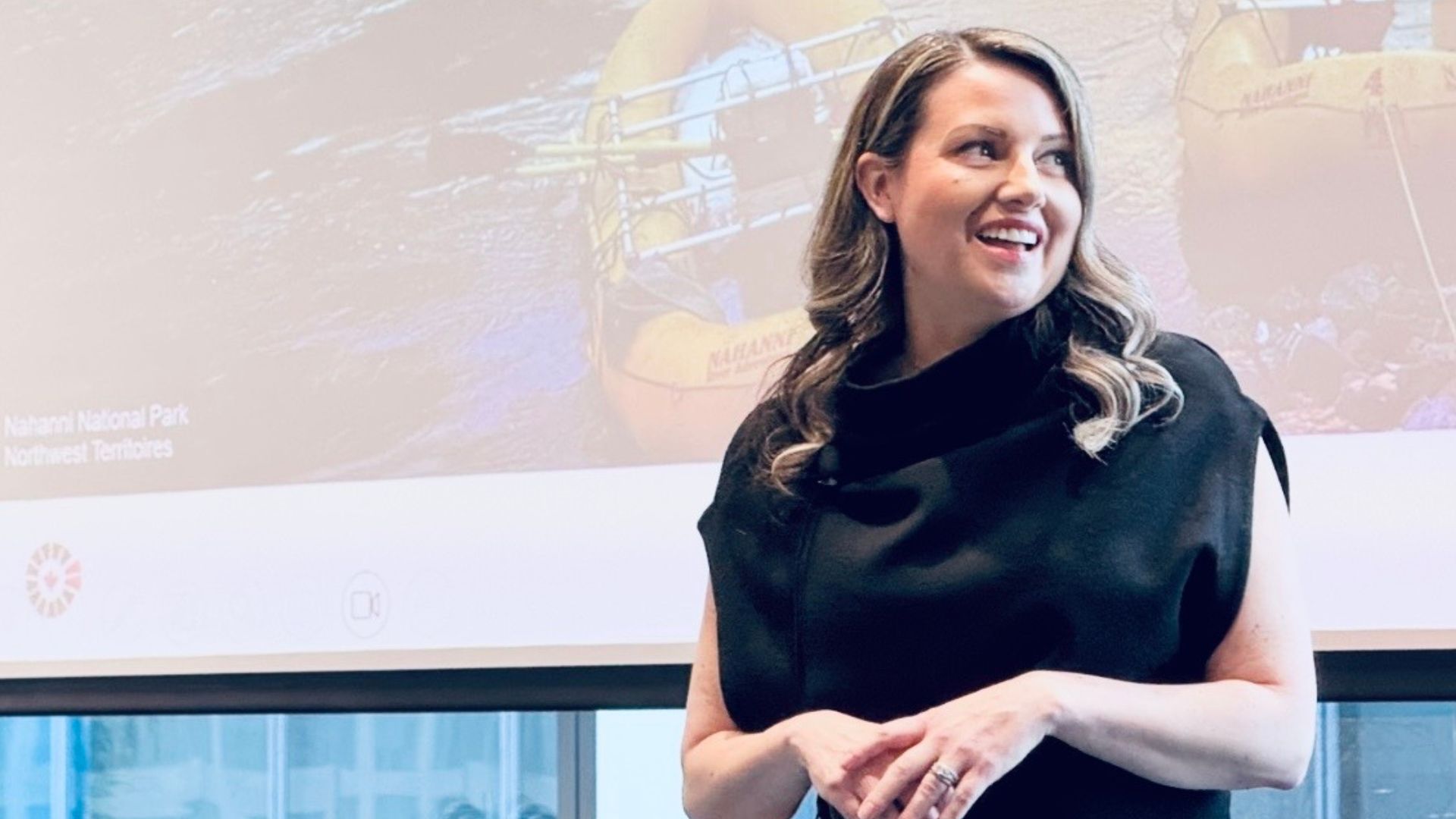
Destination Canada's Meaghan Ferrigno presenting at the Resonance AI FutureLab.
For comparison: the internet took roughly 15 years to go from novelty to genuinely restructuring how destinations marketed themselves. Social media took about a decade. The shift from search to AI-mediated discovery in travel is happening in months. The organizations waiting for the technology to mature before acting are not buying time. They are losing ground in real time, to competitors whose stories the algorithm already knows.
This is the uncomfortable core of what we heard at our AI FutureLab at the Microsoft Innovation Centre before the City Nation Place Americas conference in Vancouver. We brought together Pamela Saunders of Microsoft, Janette Roush of Brand USA, Meaghan Ferrigno of Destination Canada, Richard Werner of Upstate Colorado Economic Development, and Stefan Hawes of Destination Vancouver with place marketing leaders from across North America for exactly the kind of industry exchange this moment demands.
The day clarified something with uncomfortable specificity: how few place marketing organizations have actually begun the work these leaders were describing — and how much of that gap is not complacency, but teams just not knowing where to begin. The pattern we kept hearing was the same: “I know this matters. I don’t know where to start.”
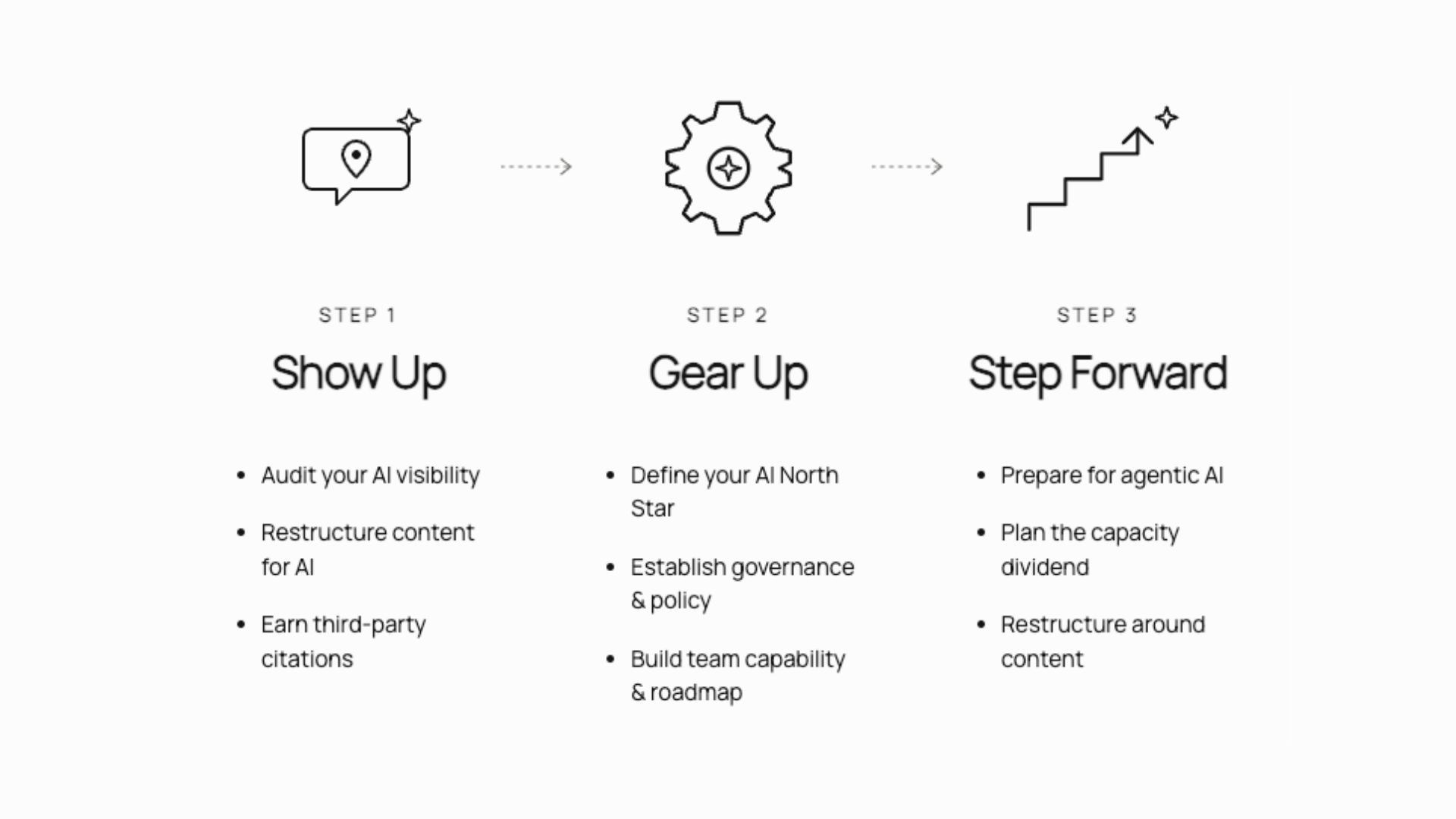
So here is a simple road map. There are three steps to your place’s AI future, and they are sequenced for a reason.
1. Show Up — Become visible to the algorithm in the channels your audiences are now using
2. Gear Up — Build the internal capacity and governance to leverage AI as a force multiplier (vs force replacement)
3. Step Forward — Prepare for the agentic future, where AI operates on your behalf
Most destinations are still on Step 1. Many have not started. A small number of leading organizations are working seriously on Step 2. Almost no one is operationally ready for Step 3.
The right strategic question is not whether you are doing AI well. It is: which step are you actually on, and what is the next move?
This is where the immediate damage is being done, and where the most immediate opportunities lie. It is also the step most place marketing organizations have not yet started, because the tools and metrics they have always relied on – sessions, organic traffic, ranking position – were never designed to measure visibility inside AI platforms.
Meaghan Ferrigno of Destination Canada has the clearest framing for the shift: the industry has moved from B2B and B2C to B2Bot now as well. There is now a machine in the middle of every relationship that matters – between destinations and travelers, between DMOs and trade partners, between content and the audiences it was built to reach. The question is no longer if you rank on page one. It is how legible you are to the bot, across every channel that bot is reading.
Search traffic to destination websites is down 30 to 40 percent in many places. AI-generated summaries now appear above more than half of U.S. Google searches, and when they do, click-through to actual websites drops by nearly half. Tripadvisor has told investors that organic search will deliver less than 10 percent of strategic gross booking value going forward. In place of that traffic? An AI algorithm producing synthesized answers about where to go, where to live, and where to invest. If your city or region is not in the answer, you are not in the consideration set.
The destinations that win AI visibility are not necessarily the ones with the best websites. They are the ones whose story is told consistently, accurately, and authoritatively across the widest possible range of sources the algorithm trusts.
This is a radically different challenge than SEO – and it has acquired its own name. Practitioners now call it Generative Engine Optimization, or GEO: the practice of ensuring that AI systems recognize your place as a credible, relevant answer to the questions your audiences are actually asking. Where traditional SEO optimized for a ranked position in a list of links, GEO optimizes for inclusion in the synthesized answer itself. For place marketing organizations, the implication is significant: the content strategies, earned media programs, and community story alignment you have always done are now the primary infrastructure for AI visibility. A story in a major travel title or respected trade journal does more for your GEO standing than 100 pages of owned content. Distributing your story across trusted publications can lift AI citations by up to 325 percent compared to publishing only on your own site. Interestingly, those citations can come from publications your target audiences don’t even read – because the bots read everything.
There is also a risk in what these systems do well that goes beyond simple invisibility. AI models are trained on an enormous average of how places have been described – “beautiful coastlines,” “vibrant culture,” “world-class cuisine,” “four-season destination” – and the gravitational pull of that training data is toward the homogeneous middle. Now add the second layer: if every DMO uses the same AI tools to generate their content, they will produce convergent outputs that make destinations sound increasingly alike. This is the sea-of-sameness problem turbocharged. Industry researchers tracking AI content output describe it bluntly: “All of the content is merging to look very, very similar.”
Whatever is irreducibly true about your place – what it actually feels like to be there, what locals will not stop talking about, what a first-time visitor is genuinely surprised by – is what survives the summarizer. The human specificity of your place story is not just good branding. In an AI-mediated world, it is the only thing that prevents you from being summarized into invisibility alongside ten thousand destinations using the same words. Specificity is the moat.
Werner’s team addressed this by working with consultant Bird Global Advisory’s Mirror Method: comparing what the community believes about itself, what the data shows, and what AI is actually reporting – then producing a scored gap analysis. The goal is not just to know your AI Alignment Score. It is to close it deliberately, with structured content and a coordinated community story.
The work of Step 1:
Audit what AI is saying about you, now. Run 20 to 40 prompts across ChatGPT, Gemini, Perplexity, Claude, and Google’s AI results using the questions your audiences would actually ask. Document where you appear, how you are described, which competitors appear instead of you, what claims are inaccurate, and which sources the AI appears to trust. Most organizations have never produced this baseline.
Restructure your content for machine ingestion. AI models scan for clear, direct answers to specific questions. Lead all posts with the answer. Use FAQ structures, schema markup, and structured data. The test: would the first 150 words of any high-intent page, extracted on their own, accurately describe your place? If not, rewrite it.
Earn citations off-site. AI draws from a wide range of trusted third-party sources. A story in a major travel title or respected trade journal does more for your AI presence than 100 pages of owned content. Earned media is no longer a campaign tactic. It is infrastructure — and the primary lever for improving your GEO standing.
Align the community story. A region that tells disconnected stories gives AI disconnected signals. The strongest AI presence belongs to destinations whose narrative is shared, repeated, and amplified across tourism boards, chambers, civic leaders, partners, residents, and creators. AI just raised the stakes on work place brands have always done.
This is the unglamorous, foundational layer. It is also where the largest pool of unrealized value sits. If you are missing from the answer engines today, no amount of agentic strategy tomorrow will recover the audience you lost in the meantime.
All of which is to say: the audit is the easy part. The work that follows – restructuring a content library that may run to thousands of pages so it reads cleanly to a machine, earning citations across dozens of trusted third-party publications, orchestrating a community narrative across stakeholders who don’t always agree on what the place even is – is months of work, not weeks. The consulting market is full of organizations that will produce the audit. The list shortens considerably when you ask who will do the rebuild with you. The assessment is the part that fits inside a presentation. The execution is the part that determines whether anything actually changes.
Where Resonance can help: The AI Place Audit
Most organizations do not know where they stand – and the ones that find out usually wish they had looked sooner. Resonance’s AI Place Audit gives you a clear baseline: your visibility benchmarked against peer destinations, scored across different target audiences, with the specific gaps and inaccuracies the algorithm is working from.
The audit is free to start, which matters for smaller DMOs and economic development organizations working with constrained budgets. You do not need a large team or a data infrastructure to begin – you need to know what the machine is saying about you before you can do anything about it. From there, ongoing monitoring and a full content alignment program are available for organizations ready to close the gap systematically. Get in touch to begin.

Destination Vancouver's Stefan Hawes presenting at the Resonance AI FutureLab.
Step 2 is the inside game. It is less existential than Step 1 and harder to externally monetize, but it determines whether your team uses AI individually to do small tasks, or collectively to unlock new capacity.
Pamela Saunders of Microsoft offered a useful framing at the April AI Lab: place marketing organizations are now operating in conditions of signal velocity that human teams cannot keep up with alone. Media coverage, social chatter, search behavior, creator content, stakeholder sentiment, partner activity, and performance data arrive continuously. The bottleneck is rarely creativity. It is the gap between a signal appearing and the team understanding what to do about it. AI, used well, closes that gap.
The catch is that “used well” is not what is happening in most organizations. Janette Roush, Chief AI Officer at Brand USA, describes the dominant pattern as “shadow AI”: talented individuals using consumer tools in personal accounts, without policy, without governance, and without shared learning. Sensitive stakeholder data ends up in tools that train on it. Useful prompts and workflows leave with departing employees. One person learns a faster way to work while the rest of the team keeps grinding the old way.
Roush’s analogy is pointed: you would never let a departing employee keep their email account, but most organizations are letting them keep the AI conversation history that contains the institutional memory of how the work actually gets done.
This problem is not unique to large organizations. In fact, it is often worse in smaller ones, where there is no dedicated AI lead, no technology committee, and no one whose job it is to figure this out. For publicly funded organizations – which describes most DMOs and economic development agencies – there is an additional layer: strict compliance and security requirements that limit access to emerging platforms, teams waiting for IT approval before experimenting with new tools, and no clear mandate for who owns AI adoption. The shadow AI pattern thrives precisely in the four- to twelve-person DMO or EDO where everyone is already wearing three hats and the idea of building an AI governance framework from scratch feels like one more impossible thing.
There is also a broader shift in what DMO leaders are being asked to do that this governance gap complicates. The role of the destination marketing organization is expanding beyond promotion into what industry observers now call destination stewardship: managing visitor flow, resident sentiment, community benefit, and long-term place health alongside the traditional marketing mandate. AI is reshaping all of these responsibilities simultaneously – not just the content production side. The organizations that will navigate this expanded mandate well are the ones that build the internal AI infrastructure now, so they can deploy it with intention across the full scope of what they are being asked to do.
Before any of the operational work — the policies, the tools, the data fixes — there is one strategic question almost no place marketing organization we know has actually answered in writing: Who do we want to be in the world of AI?
Not what tools will we use. Not what tasks will we automate. But who do we want to be? What is our point of view on this technology, on what it changes about our work, on what we will and will not let it touch.
We have reviewed AI strategy documents from dozens of destination organizations in the last 12 months. Almost none of them open with this question. They open with tool selection, governance rules, or use-case inventories. The documents end up reading like IT procurement memos rather than strategic statements — which is exactly what you would expect from organizations that have skipped the foundational act of deciding what they are doing all of this for.
The AI North Star is a one-page statement, written in the organization’s actual voice, that answers a small set of questions. What is our role in our community’s AI story? What is our posture toward the technology – early adopter, fast follower, deliberate skeptic? What is the relationship between AI and the people who do this work – augmentation, replacement, partnership, friction? What are we unwilling to do, even if we could? What will we measure in three years to know whether we got this right?
Every piece of the operational work that follows flows from that statement. Without it, the policies become arbitrary, the roadmap becomes a wish list, and the change management becomes an exercise in negotiating with anxiety. With it, every downstream decision has a referee.
With your North Star as a guide, there are a few other key actions you can take to ensure AI is be leveraged as a collective, versus individual, force multiplier:
Those four moves are the surface of Step 2. Beneath them is the slower, less visible work of actually building the operational architecture that lets AI compound rather than scatter. Five additional pieces matter.
The AI Council. Somebody has to keep the North Star alive and decide the questions that cannot be decided by individuals working alone. A small, cross-functional group – four to six people drawn from marketing, comms, research, IT or operations, and a leadership sponsor – meeting monthly, with explicit authority to approve tools, set policy, and arbitrate cases where the right answer is genuinely unclear. The Council is also where the organization’s learning compounds. Without it, every new tool is evaluated from scratch by whoever happened to encounter it first.
The tech audit and the stack. Most organizations do not know what AI tools their teams are actually using. They have a rough sense, anchored by whatever is on the invoice, but the real footprint – free accounts, browser extensions, embedded features inside platforms already paid for – is a fog. The first move is to lift the fog: an honest inventory of every tool in use, who is using it, what data is going into it, and what it is producing. The inventory almost always reveals two problems: redundancy (multiple teams paying for variants of the same capability) and exposure (sensitive material flowing through tools the organization never knowingly approved). From the inventory comes a stack decision: which tools the organization will standardize on, which it will sunset, and which capabilities it will deliberately keep optional.
Process mapping. With the stack settled, the next question is where AI fits inside the actual work. Process mapping is the unglamorous discipline of walking through how the team produces a campaign, a research brief, an RFP response, a content calendar — and marking, honestly, where AI compresses time, where it adds risk, and where it does neither. The output is a short, plain-language map of which steps in which workflows the organization is comfortable having AI in, in what role, with what human review. It prevents both the over-eager adoption that creates rework and the over-cautious adoption that wastes the capability.
The Org AI Roadmap. The artifact that ties all of the above together. A six- to eighteen-month plan, owned by the AI Council, that sequences the work: which policies, which data fixes, which process changes, which training, which pilots, which tool transitions. It also names what is explicitly not happening in this window, so the team is not constantly being pulled into adjacent experiments. The most useful Roadmaps pair short-term delivery with long-term planning – what gets shipped in the next quarter, and what the organization is building toward in two to three years.
Change management and training. None of the above survives contact with the team if the people inside the organization remain in shadow-AI mode. The change management work is two things at once: practical, hands-on, role-specific training so everyone has access to the same capability rather than depending on the early adopters who figured it out alone; and information sharing – internal newsletters, shared prompt libraries, regular show-and-tell – so the organization compounds its learning instead of relearning it every time someone joins or leaves.
For organizations that know they need to move but do not have an internal AI champion to make it happen, Resonance offers an AI Organizational Strategy engagement: a structured process that produces a one-page AI policy tailored to your organization, a department-by-department workflow map identifying where AI creates the highest value, a tool and governance recommendation aligned to your team size and budget, and a board-ready capacity dividend plan – what your organization could do with the time AI returns to your team.
This is designed to meet organizations exactly where they are. You do not need a data science team or an existing AI strategy to begin. You need clarity on which step to take next, and a practical plan for taking it. Whether you are a two-person economic development shop or a mid-sized DMO with a board asking hard questions, the engagement scales to fit. Get in touch to learn more.
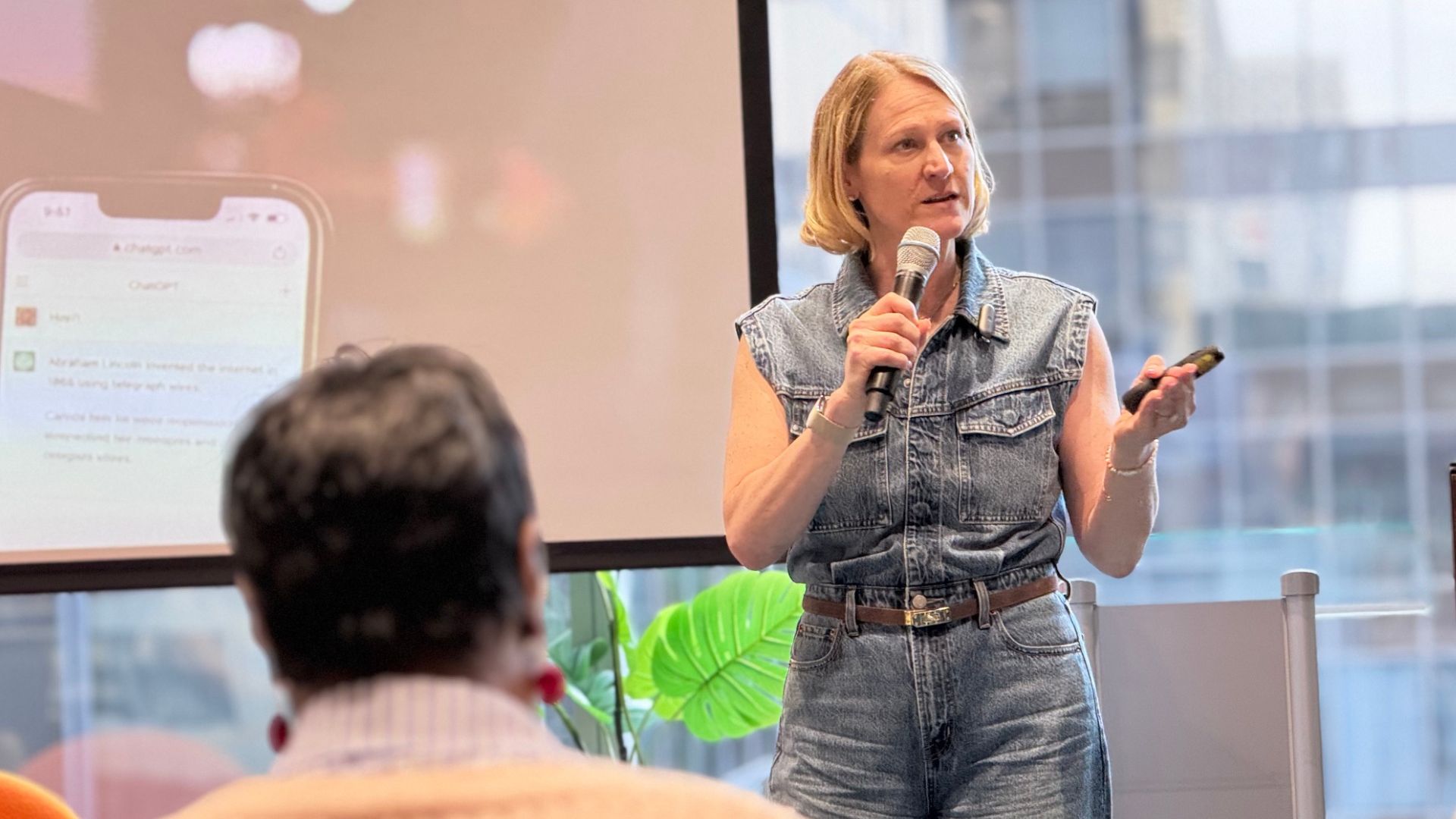
Brand USA's Chief AI Officer and SVP of Innovation Janette Roush presents at the Resonance AI FutureLab.
Step 3 is the horizon, and we want to be honest about how far away it is for most organizations.
A small number of leading organizations are beginning to think seriously about what comes after the answer engine: agentic AI, where the system does not just describe options but acts on them. A traveler plans, compares, and completes a reservation inside an AI conversation, without ever visiting a destination website, an OTA, or a search results page. The “trip planner” stops being a human session and becomes an agent-to-agent interaction.
For most organizations, this is not a 2026 problem. It is a 2027 to 2030 strategic horizon. The mistake is not failing to act on it now, but letting it distract us from the strategic energy that should be going into Step 1.
But the strategic plans being written this year — the three- and five-year frameworks that boards are approving right now — should at minimum name Step 3 as a planning assumption, and there are two questions in particular that deserve to be on board tables now even though their operational answers are years out.
There is a story the industry has been telling itself about AI that needs revising: the story of the capacity dividend.
The promise is familiar. AI compresses the time required for research, drafting, analysis, formatting. Teams recover hours, then days. The recovered time is redeployed to the irreplaceably human work — relationships, narrative, stewardship.
That promise is real. It is also, for almost every place marketing organization we know, not yet true. Right now, most teams have less capacity than they did two years ago, not more. The reasons are not mysterious: a learning curve that has not stabilized, shadow-AI use that creates rework instead of saving it, the absence of the Step 2 infrastructure that makes the tools actually compound, and a steady drumbeat of new platforms, partner expectations, and stakeholder questions that consume whatever time the tools recover.
The capacity dividend is a 2027 to 2030 question, not a 2026 one. Boards approving strategic plans this year should treat it as exactly that — a planning assumption to build toward, not a budget assumption to count on. The work of Step 2 is what eventually unlocks it. The planning question for Step 3 is what the organization is going to do with the time when it arrives.
Stefan Hawes of Destination Vancouver framed this most usefully at the April AI Lab. AI is becoming very good at work with defined inputs and predictable outputs — content formatting, data analysis, follow-up communications, RFP drafting, internal knowledge retrieval. It is not good at the things that actually move a place forward: relationship capital, cultural intelligence, political navigation, institutional trust. Mapping what AI does not replace is as strategically important as mapping what it can.
The question Stefan pushed back to leadership tables – What would we do with 40 percent more capacity? – is a Step 3 question, not a Step 2 one. Most destination strategic plans have a 2030 vision. Almost none of those plans have a strong component for what the organization will do when AI frees up 40 percent of its team’s time. Build deeper partner relationships? Spend more time on community engagement? Take a real swing at investor outreach? Invest in the long, patient work of place stewardship that no algorithm can do?
There is something else worth naming. Audiences can tell. Research consistently finds that consumers detect AI-generated content as less engaging and less memorable, and public sentiment toward AI in everyday life is more anxious than enthusiastic. The market is already pricing in a premium for what feels human-made. The capacity dividend, properly understood, is not about producing more in less time. It is about giving the people who do irreplaceably human work – the relationship-builders, the storytellers, the cultural translators – the time and oxygen to actually do it.
Boards engaging this question now will not solve it in this planning cycle. They will, however, set the expectation in writing – that when the dividend arrives, it is being redeployed, not absorbed.
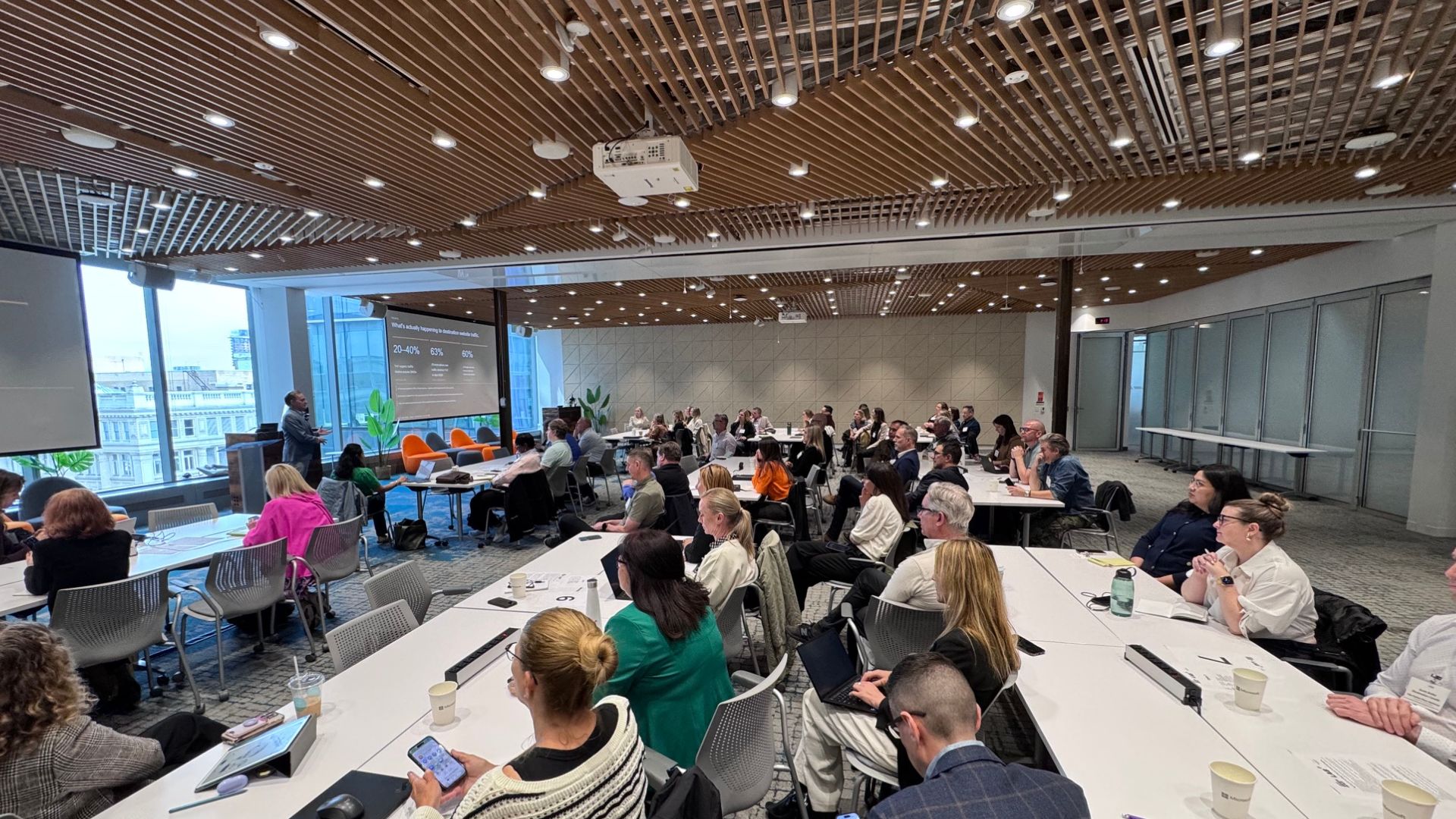
The Resonance AI FutureLab is in session
Stefan has been pushing a sharper version of the capacity question inside his own organization, and it is one we expect more destination boards to be confronting in the next 18 months. If AI fundamentally reshapes what destination marketing organizations do – and the evidence from Step 1 alone suggests it will – then the way those organizations are structured has to change too.
The legacy DMO org chart is built around channels and audiences. Meetings and conventions on one side. Leisure marketing on another. Travel trade in its own silo. Travel media adjacent. Communications somewhere alongside all of it. That structure made sense in a world where each function reached its audience through different distribution, different relationships, and different conversations.
In a world where AI is increasingly the distribution layer for every audience – where MICE planners, travel media, travel trade partners, leisure consumers, and stakeholders are all reaching the destination through the same machine-mediated conversation – the channel-by-channel structure starts to look like an artifact of the era before the bot was in the middle.
What replaces it, Stefan argues, is content. Specifically: an organization built around the production, structuring, and distribution of content that is legible to AI systems, useful to human audiences, and consistent across every conversation the destination is part of. MICE, travel media, travel trade, marketing, and comms do not disappear in this model. They become the demand-side teams pulling from a content function that has the scale, the discipline, and the data foundations to feed all of them — and that is built and resourced as the spine of the organization rather than as a support function.
If content is truly king in the AI era – and the evidence in Step 1 says it is – the question is how you build the kingdom around it. Restructuring an organization to meet this new future will be the hardest part of an place marketing organization’s AI journey.
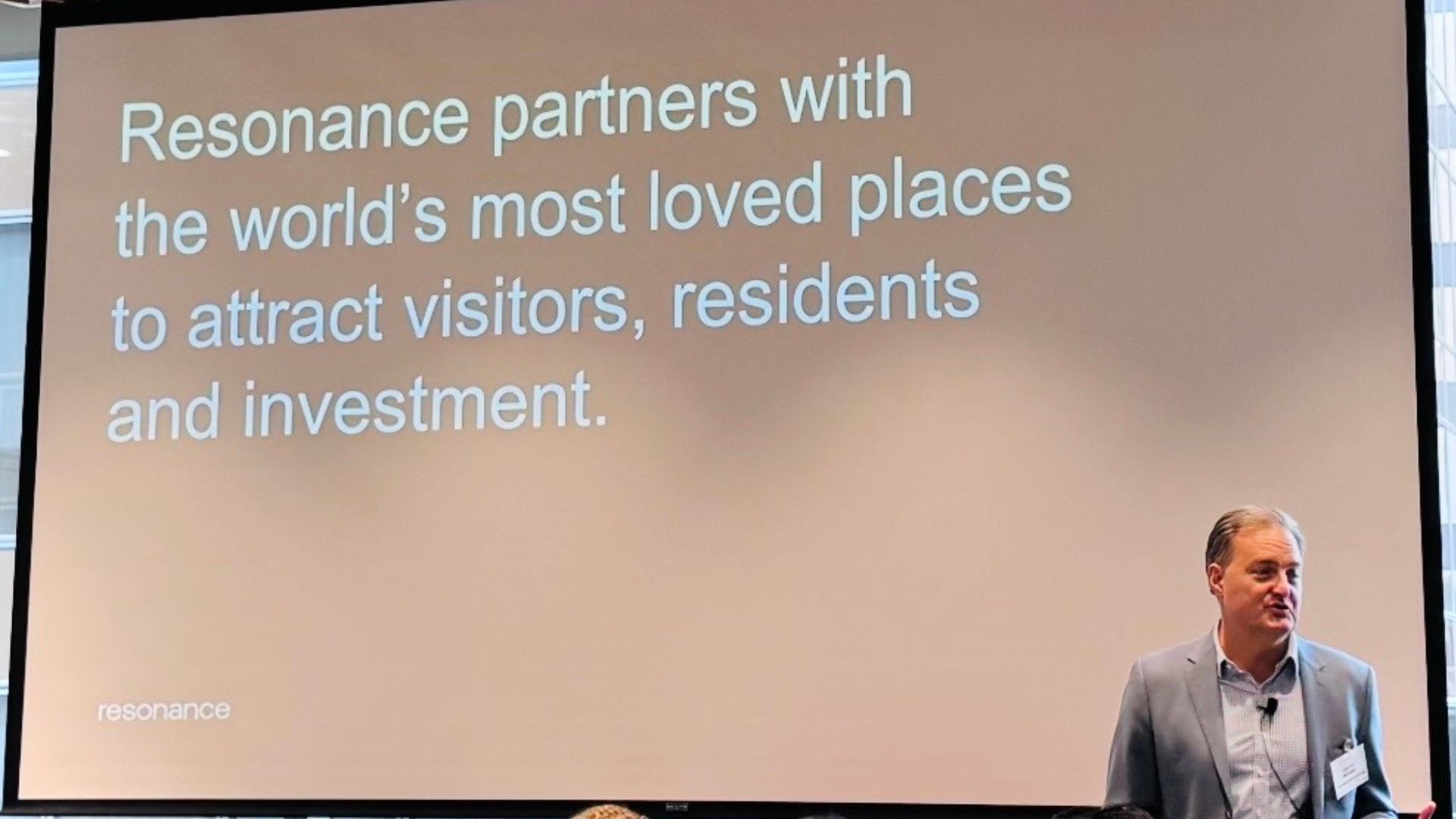
Resonance President & CEO Chris Fair welcomes the Resonance AI FutureLab participants.
Step 1 protects you from disappearing. Step 2 gives you the capacity to do the rest of your job. Step 3 prepares you for the next reordering of how places get managed, chosen and sold.
The order matters, and this is what most of our industry has wrong. Boards are debating agentic AI strategy while their destination’s visibility in answer engines goes unchecked. Marketing teams are experimenting with content generation while their data foundations produce confidently wrong outputs. Strategic plans are being written about the long horizon while the immediate, measurable disruption is happening right now, on the channels their audience is already using.
The people responsible for place – the destination marketers, the economic developers, the city brand stewards, the regional storytellers – are not being displaced by this shift. They are being asked to do the work they have always done, at a higher altitude. The skills this moment requires – orchestrating a narrative across a wide and often divided set of stakeholders, finding the honest truth of a place underneath the marketing language, earning trust through years of consistent telling, building the partnerships that turn a brand promise into a lived experience – are not skills you can prompt into existence.
The work of this moment is to be visible to the machine and irreplaceable to the human. The brief still has your name on it. It just got bigger.
We won’t pretend this is simple.
The breadth and pace of this shift – a technology reshaping how destinations are discovered, how travelers make decisions, how communities tell their stories, how organizations operate, and how places compete for visitors, talent, and investment simultaneously – is genuinely difficult to absorb. We hear this from place marketing leaders every week. The scope is vertiginous. The tools change faster than the strategies. The experts disagree. The budgets haven’t grown to match the mandate.
And yet the organizations that will come through this well are not the ones that figure it all out at once. They are the ones that start. They run the audit. They write the policy. They map one workflow. They have the board conversation. They take one step, learn from it, and take the next.
The question is not whether AI will change place marketing. It already has. The question is whether your organization will navigate that change on your terms, with intention – or get carried along by it.
Resonance has spent 20 years helping destinations, cities, regions, and economic development organizations find their story, communicate it with clarity, and compete effectively for the audiences that matter most. AI doesn’t change that mission. But it has changed the field of play.
We are here to work through this with you – one step at a time, at whatever pace your organization can move, starting from wherever you actually are. No judgment about where that is. Just a clear-eyed look at what the algorithm is saying about you today, and a practical path toward something better.
Most destinations don’t know. And the ones that find out usually wish they’d looked sooner. Resonance works with destinations, cities, regions, and economic development organizations at every stage of this journey – from a free AI Place Audit that takes a week to complete, to a full AI Organizational Strategy that gives your board a plan and your team a path forward. The work scales to your size, your budget, and where you actually are.
Thanks for reading all the way to the end. When you’re ready to talk, I hope to hear from you.