Destination Canada’s new way to measure tourism’s profound impact
04 March 2025
by Tim Hasid, Director of Destination Strategy

19 February 2026
by Chris Fair, Resonance President & CEO

Meaghan Ferrigno, Destination Canada’s Senior Vice President, Chief Financial Officer (left) and Chief Data & Analytics Officer, and Janette Roush, Chief AI Officer and SVP of Innovation at Brand USA, are deploying long-term strategies to bring their respective sectors along on the AI journey.
Your destination’s greatest competitor is no longer another property, city, or country, but the algorithm in your visitor’s pocket. In 2026, we have entered the era of the Algorithmic Welcome, where the difference between a booked trip and total invisibility is determined by if (and how well) you primed voracious large language models and their AI agents. For leaders in place branding, hospitality, and economic development, the mandate has shifted: as Destination Canada’s SVP Chief Financial Officer & Chief Data & Analytics Officer Meaghan Ferrigno advises below, you must be legible to the machine to remain irreplaceable to the human.
This half-day intensive is designed as a masterclass in building AI resilience. From 1 p.m. to 5 p.m., leadership will move past the hype to focus on the technical and organizational infrastructure required to ensure your place is found by the machine and chosen by the human. The session will explore essential data foundations, organizational readiness, and the evolution of visitor decision-making journeys through expert briefings and peer-to-peer roundtables.
Building the foundations for AI at scale offers immense potential for place marketing, but how do we ensure the industry is actually ready to use it? Destination Canada and Brand USA are answering that question in very different ways. From building centralized national platforms to democratizing access and skills, hear how Janette Roush, Chief AI Officer and SVP of Innovation at Brand USA, and Destination Canada’s Meaghan Ferrigno, Senior Vice President, Chief Financial Officer and Chief Data & Analytics Officer, are deploying long-term strategies to bring their respective sectors along on the AI journey.
Below, we present two essential, five-point perspectives on this evolution by two AI FutureLab speakers and global leaders in destination AI marketing, adoption and implementation, who will share the stage on April 21 on a session titled, “Building the Foundations for AI at Scale.”
Meaghan Ferrigno of Destination Canada explores the “B2Bot” shift and the foundational role of data, while Janette Roush of Brand USA provides the strategic blueprint for scaling AI adoption across an entire organization with unabashed confidence and wonder.

Meaghan Ferrigno, Destination Canada’s Senior Vice President, Chief Financial Officer and Chief Data & Analytics Officer
By Meaghan Ferrigno, SVP Chief Financial Officer & Chief Data & Analytics Officer, Destination Canada
What if the most important relationship in tourism is no longer human?
As AI becomes increasingly embedded in discovery and decision-making, it is reshaping how destinations compete and collaborate. At Destination Canada, we see this shift. As we prepare to meet in Vancouver, it is worth considering what it means for our industry.
1. B2Bot: There is a new intermediary in every relationship
We are moving from B2B and B2C to B2Bot. This isn’t just a consumer discovery story. The AI intermediary is showing up everywhere: between destinations and travellers, between DMOs and trade partners, between tourism businesses and investors, and between our content and the people it was built to reach. Every relationship our industry has spent decades cultivating now has a machine in the middle.
The question is no longer how do we rank on page one. It’s how do we become legible to the bot across every channel. That means being Found, with structured content and a live source-of-truth models can ingest; being Relevant, mapping offers to traveller context and optimizing for task completion; and being Authoritative, aligning narratives across partners and grounding everything in trusted data.
2. The bottleneck is us: From tools to teammates
The technology is ready. The bottleneck is us. For too long we’ve treated AI as a faster way to do existing things like drafting copy or pulling a report. That’s using a potential teammate as a search bar.
We must understand that this is a stepwise evolution. It begins with incremental gains, moves into managing bots, and ultimately matures into a trusted partner. It is super important to get beyond the mundane tasks and into a “10x’er” of your own expertise. Agentic AI can understand a goal, break it into steps, and execute across systems. But these agentic systems can only create enterprise value when paired with human experts who ensure transparency, governance, and trust. In that pairing, AI becomes a force multiplier.
Consider the potential within a national tourism organization or even a regional economic development office: the biggest value is not the tool itself, but the role and process redesign. We are moving from reactive doers to anticipatory editors. And adoption is as unique as the departments we lead.
3. Good AI requires good data
This is the lesson most learn too late: the power of AI is in grounding responses in trusted, structured, up-to-date data. Point an agent at good data, you get good output. Point it at siloed, stale, or inconsistent data, you get a confident teammate that’s wrong.
There is a prevalent narrative that you can “simply connect a foundational LLM to your sources and magic will happen.” This is untrue. A significant portion of the work is actually governance,taxonomy, metadata, security classificationsOrganizations tend to overestimate what AI can do, and underestimate what it needs.
The Canadian Tourism Data Collective was built on this principle: 230 integrated data sources and 49 billion rows of trusted data, cutting time-to-insight from 18 months to near real-time. That infrastructure isn’t the product; it’s the prerequisite.
4. Focus on your destination’s biggest questions
Start with the problem, not the technology. The destinations seeing real AI ROI did not start by asking “what can AI do?” They started with the question that changes everything. How do we win the high-value guest? How do we turn seasonality into a competitive advantage? Efficiency is table stakes; the breakthrough comes when AI reveals market potential you couldn’t see before.
5. AI will change how you’re discovered, now why you’re chosen
A bot can streamline trip planning, but the decision to travel is rooted in real experience, place, and people. AI will surface Canada if we’ve done the structural work, but it cannot manufacture authenticity.
So back to the question I opened with: is the most important relationship in tourism no longer human? No. But the machine is now in the middle of every relationship that matters. Our job is to design for both. Be legible to the machine. Be irreplaceable to the human.
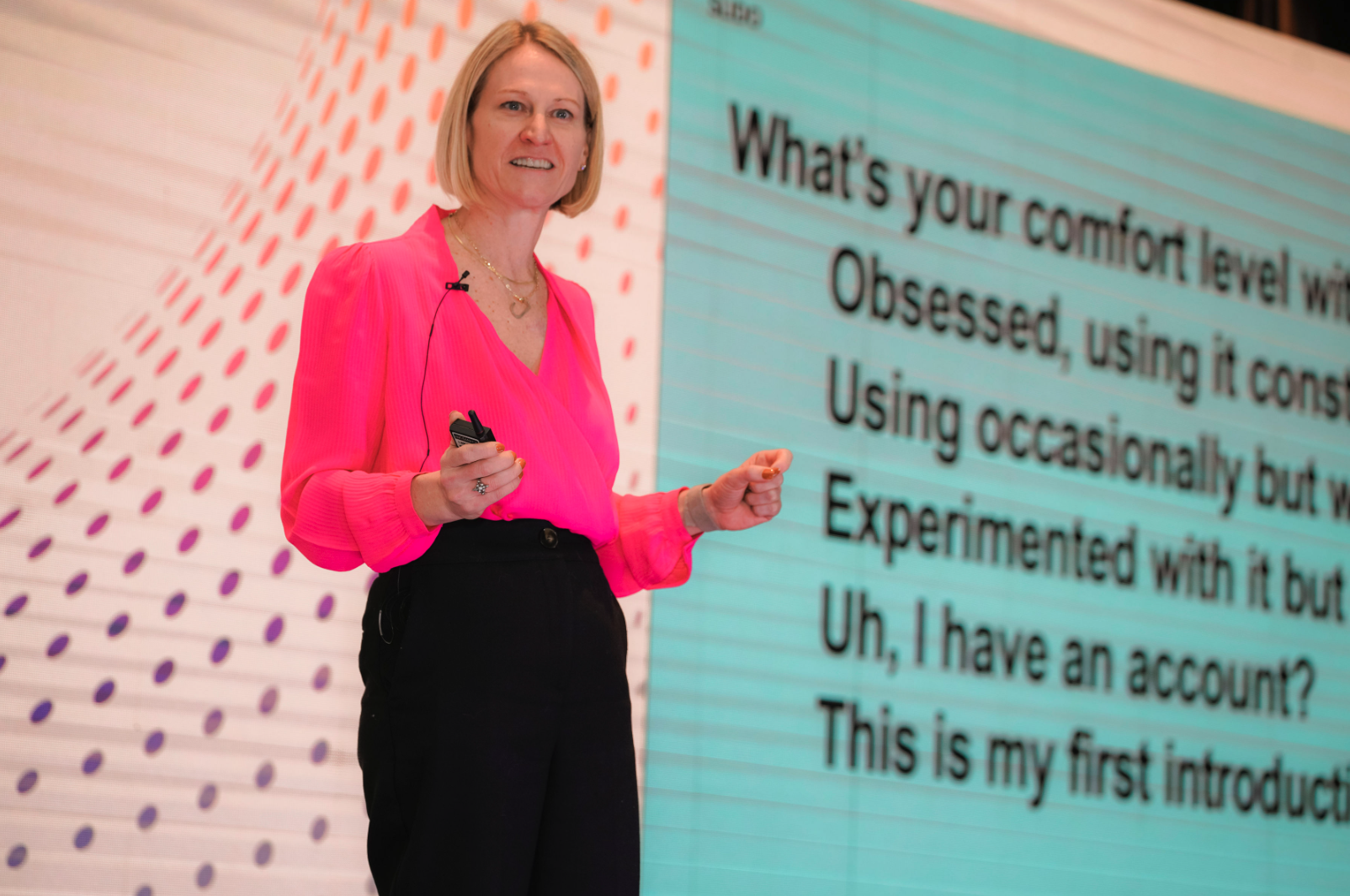
Janette Roush, Chief AI Officer and SVP of Innovation at Brand USA
By Janette Roush, VP, Innovation and Chief AI Officer, Brand USA
While Meaghan focuses on the data foundations and the “B2Bot” shift, I am obsessed with the “how” – the actual mechanics of bringing an entire organization along on this journey. You cannot mandate AI adoption; you have to encourage people to come with you.
1. Scale department by department using you org chart
Don’t try to transform the whole organization at once. Go to your org chart, pick a department, and map every responsibility that team owns. Then identify AI use cases for each area of focus. For example, if HR handles performance reviews, formalize the use of AI with shared custom prompts so the whole team benefits. This approach yields quick wins, gets everyone using AI consistently, and produces documented SOPs that become the foundation for future AI agents.
2. Provide paid, secure AI tools to eliminate shadow AI
Invest in team-level paid accounts (ChatGPT Team, Claude Team, Gemini, or Microsoft Copilot). This is non-negotiable for three reasons: it gives you SOC 2 compliance, it lets you turn off model training on your data, and it prevents “BYO AI” or shadow AI. Banning AI is a risk – people will use it anyway, just in secret. As I always say, “People drive the car faster when they know how to use the brake pedal.”
3. Create and communicate clear AI guidelines
Every AI policy must answer: What are we protecting? (security, privacy), What are we providing? (secure tools, guidance), and What are we expecting? (transparency, accountability). Don’t let perfect be the enemy of good; think of your policy as a philosophical point of view, not a legal treatise. Your team wants education and regular, consistent messaging from leadership on what’s okay and not okay to do.
4. Drive adoption through both top-down and bottom-up approaches
Leadership must set the tone by visibly using AI themselves – studies show employees are much more likely to use AI if their immediate boss does. But the bottom-up piece is critical: individual staff members need to find ways AI makes sense for their own jobs. Create regular meeting cadences – weekly or biweekly – within departments specifically to discuss AI adoption, troubleshoot broken prompts, and share learning.
5. Start small, think big… snd lead with wonder
The biggest barrier to scaling is waiting for the “perfect use case.” Don’t. Start with AI as “fancy Google” – rewriting emails or drafting boilerplate copy. Those small wins build comfort. Lead with wonder and excitement, not chastisement. Reframe the narrative: using AI at a DMO is not cheating. It’s responsible stewardship of public funds. If AI can turn a seven-hour task into a seven-minute task, that’s the responsible thing to do.
—
This is more than a workshop; it is a collaborative effort to define what an AI-ready place brand organization looks like. Join your peers to work through structure, skillsets, partner ecosystems, and alignment. The machine may decide who gets found, but the story of your place decides who gets chosen. We look forward to seeing you in Vancouver to build the foundations of that future together. And if you’re still on the fence about attending, use code “Resonance25” to save on conference registration.
As Resonance's President, Chris leads a global team in destination placemaking, branding, and marketing. Proficient in trend analysis, visioning, and city planning, he created the World's Best Cities rankings for over 400 cities in 2016. A respected speaker on tourism, real estate, and urban development, he has also chaired the Urban Land Institute's Travel Experience & Trends Council and teaches Placemaking at New York University.
Similar Articles