16 June 2026
by Chris Fair, President & CEO, Resonance Consultancy
05 August 2026
by Brandon McComas, Research Director, Resonance Consultancy
In the full America’s Best Cities ranking, size and rank move together with almost no daylight between them. New York, Los Angeles, and Chicago are the three largest metros in the country and hold the Top 3 positions. Dallas and Houston are fourth and fifth by population and land eighth and ninth. Scale compounds at the large city level: more people generate more economic activity, more cultural infrastructure, and more employer presence, which attracts more people.
At the top of the national table, size and success are largely the same thing.
But below 500,000 residents, that relationship breaks apart and deep lessons for small cities are revealed.
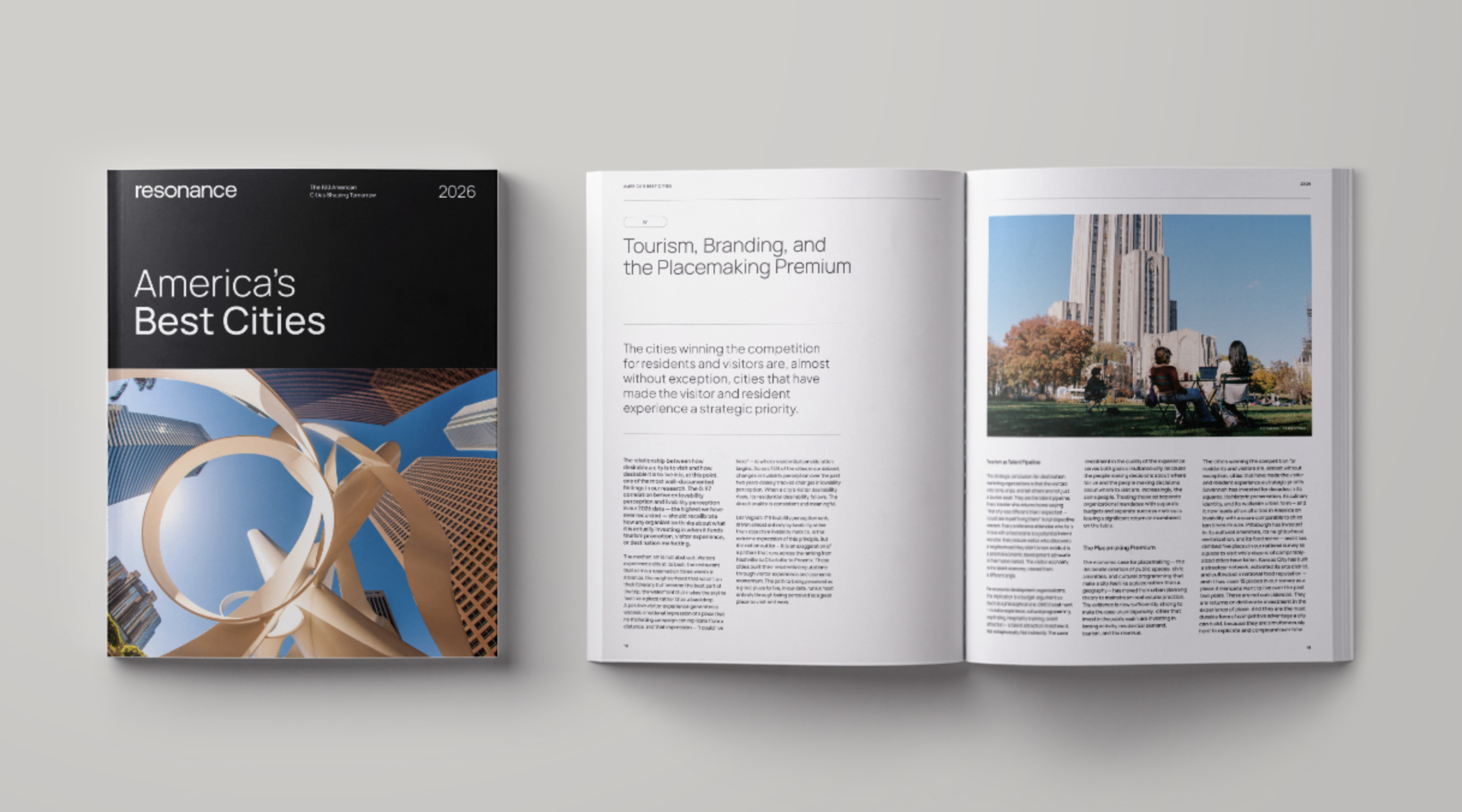
The 2026 America's Best Cities report. Download it for free at BestCities.us.
Population Stops Predicting Performance
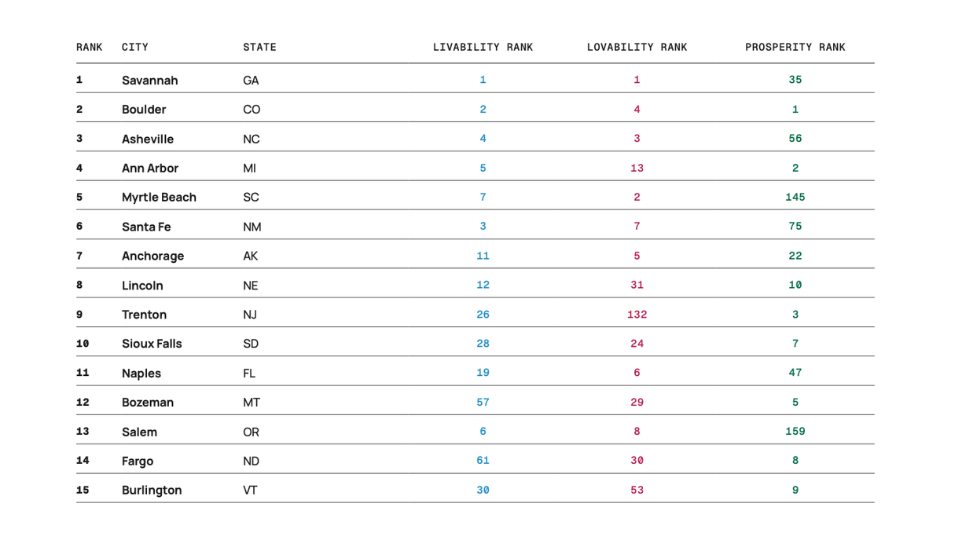
Not one of the Top 10 small cities is among the 10 largest metros by population in the small city cohort. Savannah, the top-ranked small city in America, is 17th by population. Boulder is 52nd. Sioux Falls is 60th. Santa Fe, sixth overall in the small city ranking, is 169th by population – a gap of 163 places between its size and its competitive standing.
Ann Arbor outperforms its population rank by 36 places, Lincoln by 40, Boulder and Sioux Falls by 50 each. Compare that to the large city table, where Las Vegas posts the widest gap in the Top 10 at 22 places, and where Dallas and Houston actually underperform their size.
The flywheel that carries large metros forward either doesn’t exist at small scale or spins too slowly to matter. Cities at the top of this ranking didn’t get there by accumulating mass. They got there by being something specific and then investing in that specificity consistently enough that the country noticed.
The mechanisms are worth naming, because they are replicable:
Four different routes with one shared logic. Each of these cities identified something it could be genuinely best at, and organized its economic development, visitor strategy, and civic investment around that thing rather than replicating what larger metros do at reduced scale.
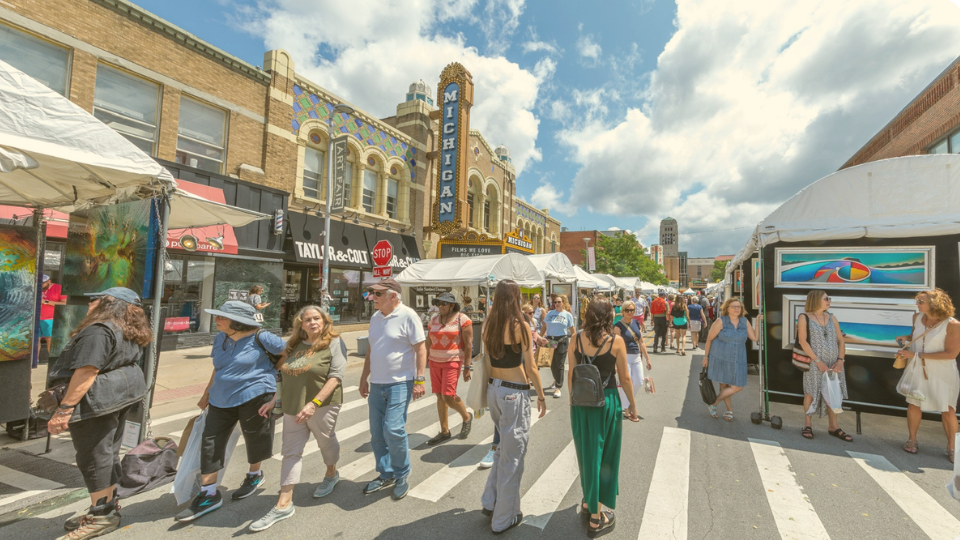
Ann Arbor, Michigan
The Anchor Institution Premium is Real, and it is Buildable
The top of the small city prosperity ranking reads like a selective university catalog.
Boulder ranks first in prosperity among small cities, powered by the University of Colorado’s research enterprise and the tech and outdoor industry cluster it has seeded across the region. Ann Arbor ranks second, where the University of Michigan’s economic and cultural footprint transforms a metro of 373,000 into a nationally competitive knowledge economy hub. Trenton, New Jersey, ranks third in prosperity and ninth overall, on the strength of its proximity to Princeton’s research enterprise and the pharmaceutical and professional services cluster that grew around it.
Two cases stand out for what they suggest about cities without an obvious institutional advantage.
Rochester, Minnesota, is a metro of 230,000 that ranks 19th overall among small cities and sixth in prosperity, anchored almost entirely by the Mayo Clinic. Its lovability score is modest – the visitor experience is not what draws people to Rochester – but the economic gravity of a single world-class institution is enough to make it one of the most attractive talent destinations in the Midwest for healthcare professionals, researchers, and the service economy that supports them.
Fargo, North Dakota, is the most surprising top-15 entry in the ranking, posting a prosperity score that its geography would not predict. North Dakota State University’s agricultural technology research created the knowledge base, but deliberate commercialization and startup ecosystem investment converted that knowledge into economic activity. The university created the conditions. The city did the work.
The lesson extends well beyond universities. A major medical center, a national laboratory, a military installation with a serious R&D mission – all of these function as anchor institutions that generate talent, economic activity, and civic identity in combinations that are very difficult to replicate through organic economic development.
For small cities that have one, the strategic imperative is making the relationship maximally productive: research commercialized locally, graduates retained, cultural programming shared, identities mutually reinforcing. For small cities that don’t, the work is building alternative differentiators – outdoor amenity, food and arts culture, specific economic specializations – that can achieve a similar anchoring effect at smaller scale.
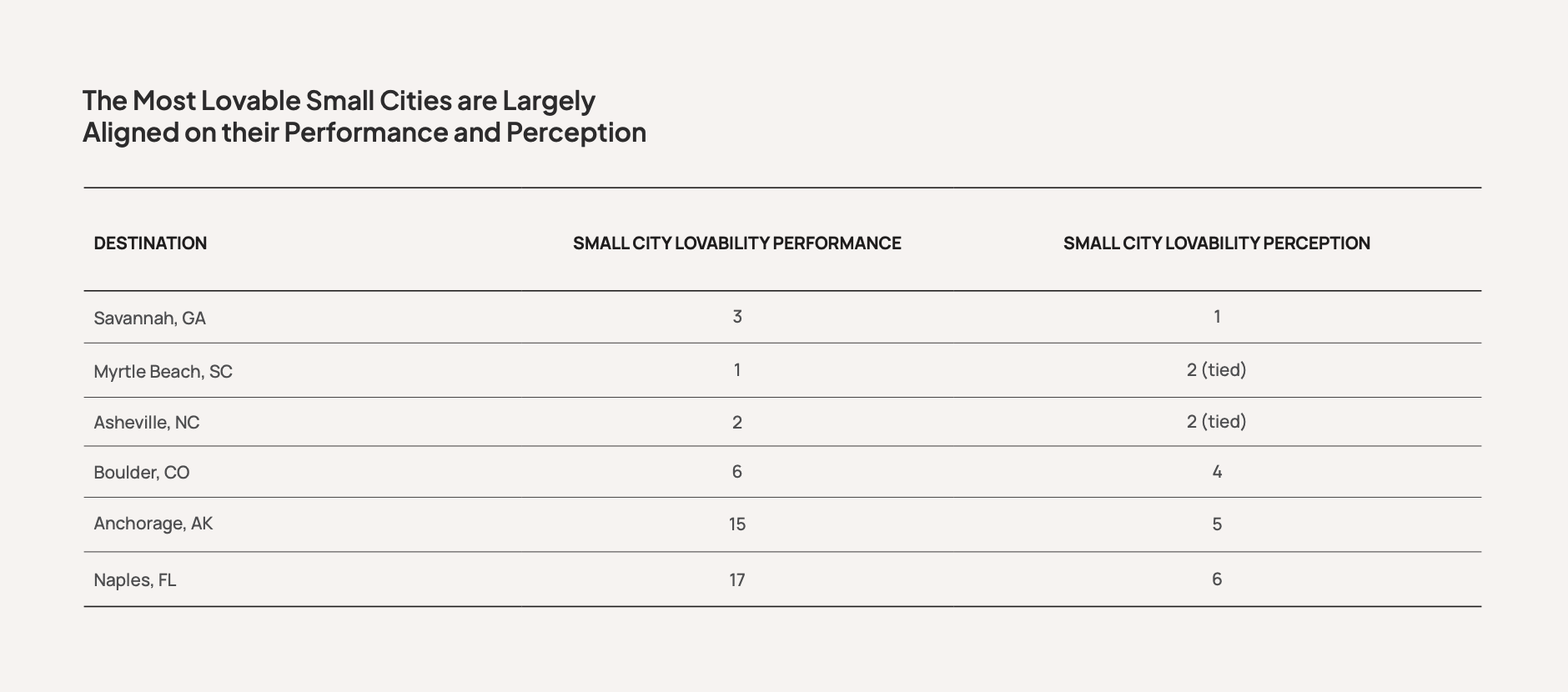
The most lovable small cities are largely aligned on their performance and perception.
Only 43 Small Cities Are on the National Perception Map
Here is the number that should concentrate the mind of every small city marketing organization in the country.
Of the roughly 280 small metros in the 2026 dataset, only 43 appeared in our national perception survey as a place Americans want to visit. The survey, conducted with Ipsos across more than 2,000 U.S. households, uses open-ended and unprompted questions. Respondents name the cities that come to mind. For the large majority of small metros, nothing comes to mind at all.
That is not a verdict on the quality of the other 237. Building the kind of cultural resonance that puts a city on a stranger’s shortlist, from a metro of fewer than 500,000 people, is genuinely hard.
What happened to those 43 cities is the more consequential finding: 42 of them also showed up as places Americans want to live. The single exception is Atlantic City, whose visitor identity is so narrowly tied to gambling that it doesn’t translate into residential aspiration. Every other small city that earned a place in the national visitor conversation earned a place in the national residential conversation at the same time. The 0.97 correlation between lovability perception and livability perception that runs through the overall America’s Best Cities ranking – the highest we have ever recorded – holds just as firmly at small scale.
The cities that broke through share a specific characteristic: their lovability performance and their lovability perception are closely aligned. Savannah ranks third on lovability performance among small cities and first on perception. Myrtle Beach is first on performance and second on perception. Asheville is second on both. These are places that built genuine visitor experiences and then told those stories effectively enough for perception to catch up to reality.
The strategic implication depends entirely on where a city sits in that data. Charlottesville ranks 29th on lovability performance among small cities. Fort Collins ranks 19th. Bellingham ranks 26th.
None of the three was named by a single survey respondent.
The assets are already built and the visitor experience is competitive. What’s missing is visibility – the sustained national presence that converts local excellence into broader awareness. That is a communication problem, and it is a solvable one.
For small cities with modest lovability performance, the direction reverses. Investment in the visitor economy comes first: restaurants, cultural programming, walkable public space, an events calendar, a hospitality ecosystem worth experiencing. Perception follows investment, in that order. The cities at the top of this ranking did not build reputations and then build experiences.
They built the experiences, sustained them for years, and let the reputations follow.
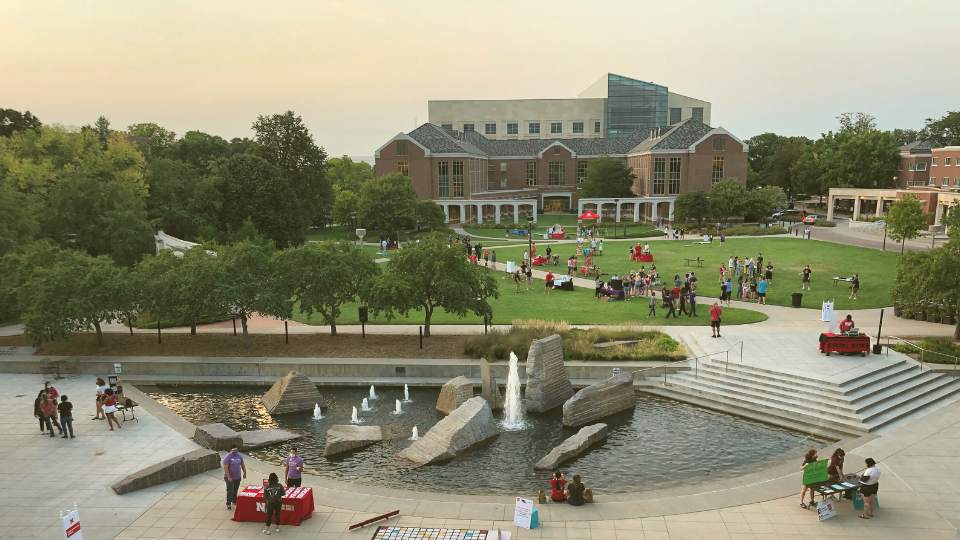
Lincoln, Nebraska
Being Indispensable Beats Being Famous
A third group at the top of the small city ranking fits neither the university model nor the visitor experience model. These cities compete on economic specialization and regional gravity – becoming the dominant provider of a sector, a service, or a regional function that generates institutional density and workforce depth out of proportion to their size.
Sioux Falls is the clearest case in the dataset, ranking tenth overall with a prosperity rank of seventh. A financial services cluster has made it one of the most important banking hubs in the country, Sanford Health and Avera anchor a regional healthcare system, and a favorable cost structure keeps drawing corporate back-office and distribution operations. South Dakota’s banking regulations created the initial conditions, but the city built the workforce, the real estate, and the quality of life that kept companies there.
Billings, Montana, ranks 32nd in the cohort on the strength of a regional hub function that most economic development conversations undercount. It serves as the dominant center for healthcare, retail, professional services, logistics, and air connectivity across much of Montana, northern Wyoming, and the western Dakotas. Lincoln operates the same way within Nebraska – not only a university town but the regional anchor for a broad swath of the Great Plains, drawing workers and businesses from a geography far larger than its population suggests.
Industry cluster development is one of the best-documented paths to small city economic resilience in the literature and one of the most underinvested in practice. It demands a longer time horizon than event attraction or incentive packages, and it requires coordination between city government, anchor employers, workforce development institutions, and regional partners that is difficult to sustain. The cities that have managed it – Sioux Falls, Fargo, Rochester, Billings, Lincoln – built advantages that competitors cannot replicate quickly.
The Top 15 America's Best Small Cities in 2026
What the Small City Data Shows City Leaders
Four principles hold across the ranking, regardless of a city’s region or starting position.
Specificity outperforms scale. The question for any small city reading this ranking is not how to become bigger. It is how to become more visibly and more consistently what it already is.
Lovability is the most efficient lever available. Livability performance and livability perception correlate at just 0.49 nationally, meaning half of what determines how livable a city is perceived to be has nothing to do with how well it functions. Lovability performance and perception correlate at 0.92. A great visitor experience cannot be faked and cannot be hidden.
Anchor institutions are worth more than most cities extract from them. Boulder, Ann Arbor, Rochester, and Fargo differ enormously in geography and economy. What they share is a city that treats its anchor as a partner in economic development rather than as a large tenant.
Visibility and quality are separate problems with separate solutions. Charlottesville and Fort Collins do not need better visitor experiences. They need to be talked about. Diagnosing which problem a city actually has is the first strategic act, and getting it wrong wastes years.
The competitive field is wider than it has ever been, and the pool of mobile, working-age Americans that cities are competing for is contracting. Small cities are not disadvantaged in that environment by default. Twenty-four of them are already in the national Top 100, and the ones that keep rising will be those that know precisely what they are worth choosing for.
Download the full 2026 America’s Best Cities report, featuring rankings, data, and strategic analysis for all 393 U.S. metropolitan areas and the first-ever standalone ranking of America’s 100 Best Small Cities – and reach out if you’d like to talk through the perception and performance of your city, we’d love to chat.
Similar Articles
16 June 2026
by Chris Fair, President & CEO, Resonance Consultancy
10 April 2024
by Chris Fair, President & CEO, Resonance