How ‘destination stewardship’ succeeds where ‘sustainable tourism’ stumbled
Insights — 13 June 2024
by Chris Fair, President & CEO, Resonance

Insights — 02 December 2025
by Chris Fair, Resonance President & CEO

Meta trends are different from ordinary trends: less about incremental shifts in consumer preferences or short-term market reactions and more tectonic realignment. They are structural, overarching, long-term changes that drive and shape numerous other trends. And they’re accelerating.
The five meta trends we’ve identified – reglobalization, wealth concentration, social isolation, climate adaptation, and agentic AI – are not only disrupting how we travel, but fundamentally reshaping how we plan, market, and manage the places we live, visit, and invest in.
If you’re leading a destination, city, or resort community anywhere in the world, these are the forces you need to understand now to ensure long-term prosperity and relevance in a rapidly changing world.
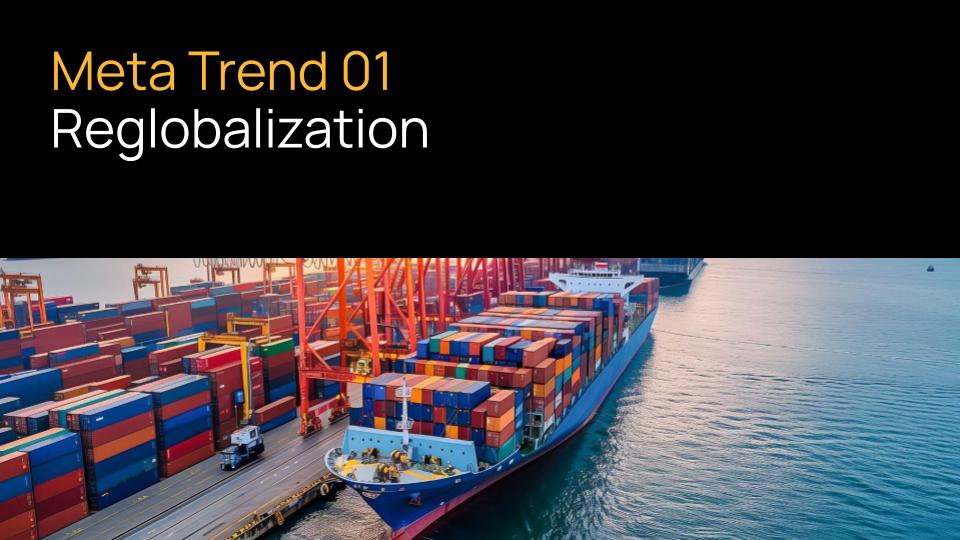
Meta Trend #1: Reglobalization
Let’s start with one of the most significant but underdiscussed dynamics reshaping tourism: reglobalization.
For decades, globalization has been synonymous with growth in intercontinental trade and long-haul travel. But today, that’s reversing. In 2023, the volume of world trade in goods and services grew by only 0.2%, the weakest pace in 50 years. Looking ahead, the slowdown continues. World merchandise trade volume is projected to grow by just 2.8% in 2024, 2.4% in 2025, and a mere 0.5% in 2026.
What’s growing instead? Regional travel and trade. Between 2025 and 2030, intra-regional travel is expected to outpace inter-regional (long-haul) travel growth across the globe’s major tourism regions. In Europe, 70% of travel will be regional by 2030, up 5% from today. In Asia Pacific, intra-regional travel will account for 64%, up 4%.
Meanwhile, inter-regional long-haul air travel is increasingly flowing through key global mega hubs: Dubai, London, Singapore, New York, Seoul, Amsterdam, Paris, Istanbul, Frankfurt, and Toronto. These cities are becoming the essential connectors in a new geography of global mobility… and destinations that aren’t directly connected to these hubs face growing competitive disadvantages.
What this means for destinations worldwide: The era of spreading marketing budgets across dozens of international markets is ending. The new paradigm requires a more sophisticated approach: operating within a holistic global marketplace rather than targeting isolated markets. This means understanding global flows, not just bilateral relationships. It means diversifying airlift strategically, digitizing marketing pipelines to reach travelers wherever they are, and forging deeper regional connections that can serve as foundations for international growth.
For peripheral destinations – those not located near or directly connected to major hubs – the challenge is particularly acute. These places must become destinations worth the detour, offering experiences so compelling that travelers will actively seek them out despite connectivity barriers. The answer lies in creating legendary, differentiated experiences and leveraging digital channels to build desire long before the booking window opens.
Meta Trend #2: Wealth Concentration
The second seismic force reshaping travel is wealth concentration, and its impact on tourism is nothing short of revolutionary.
Globally, roughly 75% of all wealth is now held by the Top 10%, and about half by the Top 1%. That’s approximately 80 million people who form a powerful consumer bloc, often shaping entire industries. And nowhere is their influence more visible than in travel.
In the United States, consumer spending by the wealthiest 10% of Americans has surged from roughly 36% in the 1990s to approximately 50% in 2024. This isn’t just more affluence: it’s more influence. Similar patterns are emerging across Europe, the Middle East, and parts of Asia.
The result? A clear bifurcation of the travel market. High Net Worth travelers are seeking bespoke offerings – rare, personalized, often private experiences that money alone can’t easily buy. They’re looking for heli-skiing in untouched valleys, private art safaris with renowned curators, exclusive culinary journeys with Michelin-starred chefs in their homes. Meanwhile, middle- and lower-income travelers are consolidating around cruises and all-inclusive packages that offer predictable value.
The data reflects this shift across major markets. In North America and Europe, only the Luxury and Upper-Upscale hotel classes achieved occupancy growth in 2024, while mid-market properties struggled. Hotel development pipelines globally are tilting heavily toward the upper end, with more than 40% of new rooms in many markets falling into the Upscale to Luxury tier.
The Top 1% aren’t just traveling more frequently, they’re traveling differently. In Resonance’s newest research, we’ve found that wealthy travelers from the U.S., Europe, Middle East, and Asia increasingly seek destinations that offer not just luxury, but transformation. They want experiences that can’t be replicated, stories they can’t Google, and connections that feel authentic and earned.
What this means for destinations worldwide: Every destination must make a strategic choice: are you designing for the mass market or the high-value traveler? Increasingly, trying to serve both means serving neither well.
Destinations that choose to pursue high-value travelers must understand that this isn’t just about offering premium products, but creating transformational experiences. Luxury today is no longer about exclusivity for its own sake. It’s about exclusivity with meaning. Experiences that express deep cultural authenticity, environmental stewardship, and genuine human connection will win.
This also means reconsidering your product mix. Are your hotels positioned for this market? Are your experiences designed with intention, or are they merely activities? Do you have the right partnerships with luxury travel advisors, private jet companies, and high-end concierge services?
For destinations that choose to focus on volume and middle-market travelers, the imperative is different: maximize convenience, value, and accessibility. Invest in all-inclusive infrastructure, cruise terminals, and efficient transportation. Make booking simple and pricing transparent.
The middle ground is becoming increasingly difficult to defend.

Meta Trend #3: Social Isolation
We are living in an era of paradox: more connected than ever through technology, yet more isolated than we’ve ever been as human beings.
Social isolation, driven by solo living, remote work, and digital immersion, is one of the most important meta trends reshaping modern society. This isn’t a problem unique to any single country; it’s a global phenomenon that’s remaking the social fabric of developed economies worldwide.
Consider the data: In Canada, one-person households have grown from 7.4% in 1951 to 29.3% in 2021. Similar patterns appear across the developed world. The United Nations projects that by mid-century, 35% of households worldwide will consist of a single person. In cities like Stockholm, Manhattan, and Tokyo, that figure already exceeds 50%.
Overlay this with work trends: Remote and hybrid work have fundamentally restructured when, where, and how we work. In Canada, 13% of workers are fully remote and 10% are hybrid. In the U.S., it’s 10% remote and 30% hybrid. In Europe and parts of Asia, similar transformations are underway. What we’re witnessing is a deep rewiring of time, space, and mobility.
But here’s what makes this particularly relevant for tourism: isolation creates hunger for connection, and travel has become one of the primary ways people seek to fill that void.
As a result, three powerful sub-trends are emerging:
1. Solo travel is booming: The global solo travel market size is expected to double in the next five years, reaching $1.07 trillion by 2030, growing at a CAGR of 14.3% from 2025 to 2030. Solo travelers aren’t just single people – they’re married professionals taking personal retreats, recent retirees exploring new identities, and digital nomads building location-independent lives.
2. Business travel is bouncing back: Despite predictions of its demise, business travel spending is expected to surpass $2 trillion globally by the end of the decade, with CAGR of 8-9% in North America and similar growth in Europe and Asia. Why? Because after years of Zoom fatigue, organizations have rediscovered the irreplaceable value of face-to-face connection.
3. Events are resurging: The global events industry market size is forecast to increase by $1.07 trillion at a CAGR of 13.5% between 2024 and 2029. Conferences, festivals, and gatherings of all kinds are experiencing renaissance because they fulfill a deep human need: to be part of something larger than ourselves.
What this means for destinations worldwide: Places that embrace this shift – by designing for solo travelers, digital nomads, and work-from-anywhere professionals—will unlock extraordinary new demand.
This means rethinking the entire visitor experience. Solo travelers need spaces where they can easily connect with others without forced socializing. They need flexible accommodations that don’t penalize single occupancy. They need activities designed for individuals that create natural opportunities for connection.
For business and event travel, destinations need co-working-friendly infrastructure, hybrid event formats, and “bleisure” programming that seamlessly blends business and leisure.
But most fundamentally, destinations need to become connective tissues – places that reconnect people to people, people to nature, and people to purpose. In an age of isolation, the destinations that win will be those that help visitors feel less alone.
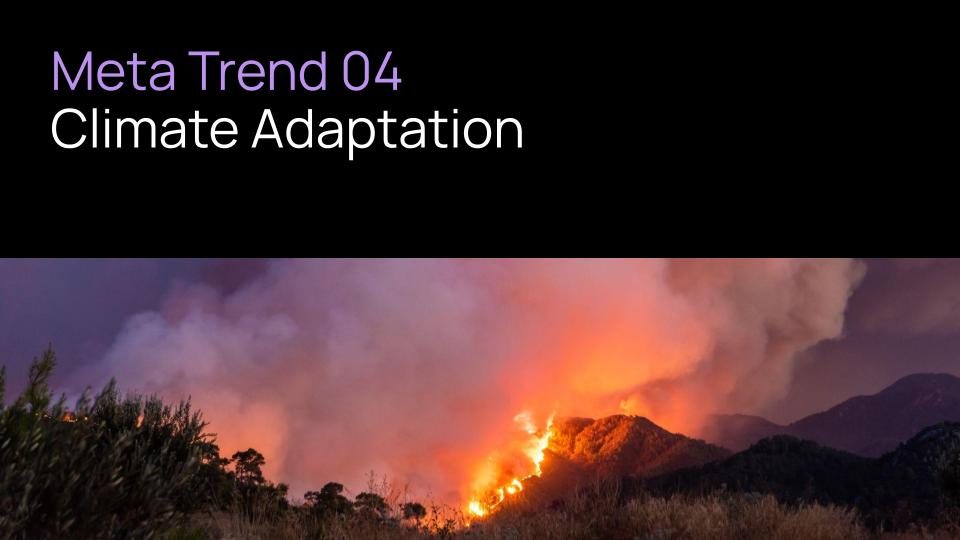
Meta Trend #4: Climate Adaptation
Next, let’s talk about what may be the most existential meta trend for travel: climate adaptation.
In 2024, global temperatures exceeded the pre-industrial average by about +1.6°C, making it the warmest year on record. And the impacts are already reshaping travel patterns in profound ways.
Traditional warm-weather destinations are seeing summer visitation soften as temperatures become uncomfortable or even dangerous. Mediterranean destinations regularly hit 40°C+ in summer months. Middle Eastern cities become nearly uninhabitable. Even tropical paradises are experiencing heat that drives tourists away rather than attracting them.
Meanwhile, travelers are already adapting their behaviors. Spring and fall are emerging as new high seasons in traditionally summer-dependent destinations. The concept of a winter “escape” is being redefined – from palm trees to powder, from beaches to mountains.
Climate projections indicate ski seasons could be 1-2 months shorter by 2050 in many traditional winter sports destinations, fundamentally threatening their business models. Yet simultaneously, higher-altitude and more northern destinations may see new growth opportunities as winter becomes a rarer commodity. .
What this means for destinations worldwide: Climate adaptation creates both winners and losers in the global tourism economy. The destinations that will thrive are those that recognize and prepare for this shift now.
For cooler-climate destinations: Northern Europe, Canada, Alaska, Patagonia, New Zealand, and higher-altitude mountain regions have a once-in-a-generation opportunity to become the world’s preferred “coolcation” destinations. This means preparing for demand in new ways: building resilience against extreme weather events like forest fires, diversifying seasonality in marketing campaigns, and packaging winter as an exotic, aspirational experience.
Imagine winter escapes for affluent travelers from overheating regions – visitors from the Middle East, Southeast Asia, and Latin America seeking snow, crisp air, and the magic of winter landscapes they rarely or never experience at home. Destinations like the Norwegian Arctic, the Canadian Rockies, Hokkaido, and the Swiss Alps could become year-round powerhouses.
For warm-weather destinations: The challenge is more acute but not insurmountable. These destinations must invest in cooling infrastructure, shift marketing emphasis to shoulder seasons, and develop indoor or evening experiences that allow visitation even during extreme heat. Some may need to fundamentally reconsider their positioning – perhaps evolving from beach destinations to cultural or culinary hubs that happen to have beaches.
For all destinations: Climate adaptation requires honest assessment of vulnerabilities – from rising sea levels to wildfire risk to water scarcity – and proactive investment in resilience. The destinations that transparently address these challenges while innovating their experiences will earn trust and loyalty in an increasingly climate-conscious world.

Meta Trend #5: Agentic AI
Finally, we come to the most transformative force of all: agentic AI.
ChatGPT reached 100 million users in just two months, making it the fastest-growing consumer application in history. But the implications for travel go far beyond any single platform. We’re witnessing the emergence of an entirely new paradigm for how people discover, plan, and book travel.
In 2024, 64% of U.S. travelers said they had used or plan to use AI to plan future trips. Similar adoption rates are emerging across Europe and Asia. But agentic AI will be different from the current tools we are using. It won’t just generate suggestions or process searches – it will autonomously take actions with minimal human oversight. These AI agents can research options, compare prices, make bookings, modify itineraries, and even handle customer service issues on behalf of travelers.
As Expedia stated plainly: “Our goal is to get people to plan their travel in one place—like travel agents before internet booking took their jobs.” This isn’t hyperbole. It’s strategy. And every major travel platform – from Booking.com to Google Travel to emerging AI-native startups – is racing to build the most capable AI travel agent.
What this means for destinations worldwide: AI is no longer just an optimization tool – it’s a new distribution channel. And it will fundamentally redefine three critical dimensions of destination marketing:
Discovery: AI agents will increasingly mediate how travelers discover destinations. Instead of browsing Instagram or reading travel blogs, travelers will simply tell an AI agent what kind of experience they want, and the AI will recommend destinations. Your visibility depends not on your ad spend but on how well your destination’s data – reviews, content, structured information – teaches AI agents about your value.
Reputation: Online ratings, reviews, and media coverage will become even more important because AI agents synthesize this content to form recommendations. A destination with consistently high ratings and positive sentiment will be recommended far more often than one with mixed reviews – regardless of marketing budget. This means reputation management becomes mission-critical.
Access: Small and medium enterprises (SMEs) – the local tour operators, boutique hotels, and family restaurants that give destinations their authentic character – face a particular challenge. AI-driven platforms will increase the cost of sales and potentially favor larger operators with more sophisticated data infrastructure. Destinations must proactively help their SMEs become AI-visible or risk losing the very authenticity that makes them appealing.
For destination marketing organizations, this requires a fundamental shift in strategy. You must:
Your brand isn’t just what you say anymore – it’s what your data teaches AI agents about your value. Destinations that master this transition early will have significant competitive advantages.
Key Takeaways: From Disruption to Design
So what does this all mean for 2026 and beyond?
Place strategy has never been more complex… or more critical. The global tourism landscape is being reshaped by forces that are simultaneously fragmenting and consolidating markets, creating new opportunities while rendering old strategies obsolete.
Our worldview needs to shift from targeting individual markets to operating within a global marketplace. Our customers are becoming increasingly affluent – looking not only for luxury, but exceptional experiences that transform who they are. Our distribution channels are being revolutionized by AI in ways that will separate the prepared from the unprepared. Our seasons are shifting as climate reshapes the geography of comfort and desire. And our travelers are simultaneously more isolated and more hungry for connection than any generation before them.
But here’s the good news: destinations that respond to these forces not with fear, but with foresight and strategic creativity, will thrive. The five meta trends are not a threat: they’re an invitation.
An invitation to reimagine what luxury means in an age of wealth concentration – moving beyond amenities to authentic transformation.
An invitation to design for connection in an age of loneliness – creating experiences that reconnect people to people, people to nature, and people to purpose.
An invitation to position cooler climates and shoulder seasons as the world’s next great escape – capitalizing on climate adaptation rather than becoming victims of it.
An invitation to master AI as a distribution channel – ensuring your destination is not just beautiful in person, but beautifully represented in the data that shapes traveler decisions.
And above all, an invitation to lead with intelligence, creativity, and strategic clarity in building a more livable, lovable, and prosperous world.
The places that do so will not only adapt to the five meta trends above. They will lead it. They will define it. They will resonate.
The future of travel is being written now, and the authors are those bold enough to see these meta trends not as disruptions to resist, but as foundations to build upon.
Let’s shape that future – together. Email me at cfair@resonanceco.com and let’s set up a call to discuss how we can help make your destination, resort or community ready for the future.